 in 2026](https://file-host.link/website/quantem-bbph4x/assets/refined-images/1783679790081000_01f63e5e6b274c6983701f8864a71d0b/360.webp)
Introduction
Hospitals rank among the most navigationally complex environments in the US - sprawling campuses, dozens of departments, constantly shifting room assignments, and visitors who are already anxious before they walk through the door. The consequences of poor wayfinding are measurable: a 2025 HERD study found that 46% of hospital staff reported giving directions distracts them from primary duties, and nearly 44% had experienced incivility from frustrated visitors who got lost. A separate hospital signage study found 31% of visitors reported getting lost in hospital complexes, with 98% feeling the need to reconfirm their destination with staff.
Modern digital signage systems for hospital wayfinding have moved far beyond laminated floor maps. Today's platforms deliver interactive touch navigation, real-time department updates, mobile QR handoffs, and ADA-compliant routing - all managed from a centralized CMS.
That demand is reflected in the numbers. The global healthcare digital signage market was valued at $750 million in 2025 and is projected to reach $1.10 billion by 2030 at an 8.0% CAGR - a signal that hospitals are actively investing in solving this problem. Choosing the right system matters more than ever.
This guide covers the five best digital signage systems for hospital wayfinding in 2026 and what to evaluate before you buy.
Key Takeaways
- 31% of first-time hospital visitors get lost - digital wayfinding directly reduces staff interruptions and patient stress
- The top five systems for 2026 are Mappedin, NoviSign, Omnivex, Skykit, and Rise Vision
- Evaluation criteria should cover wayfinding-specific features, healthcare security standards, and EHR/scheduling integrations
- ADA compliance (screen reader, voice guidance, high-contrast modes) is non-negotiable for US hospital deployments
- Large kiosk fleets need a dedicated MDM layer for remote management, kiosk lockdown, and zero-touch provisioning - Quantem covers all three
What Is a Hospital Wayfinding Digital Signage System?
A hospital wayfinding digital signage system combines three core components:
- Physical displays - kiosks, corridor screens, and entrance tablets
- Content management software (CMS) - the backend that controls what each screen shows
- Interactive maps - guided navigation from entry points to specific departments or rooms
These systems replace or supplement paper maps and static directional signs with displays that can be updated instantly - reflecting department moves, temporary construction closures, or emergency rerouting without reprinting anything.
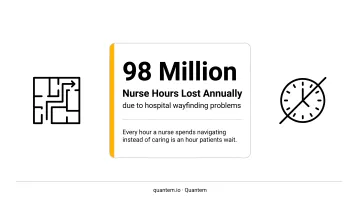
A 2025 HERD study estimated poor wayfinding consumes 98 million nurse hours annually in the US, equivalent to over 51,000 full-time positions. Every minute a nurse spends giving directions is a minute pulled from patient care - and at that scale, it's a measurable drag on clinical capacity.
That's the problem this guide addresses. The five systems below were evaluated on wayfinding-specific capabilities, named healthcare deployments, integration depth, security standards, and scalability across multi-facility networks.
Best Digital Signage Systems for Hospital Wayfinding in 2026
Mappedin
Mappedin is an indoor mapping and wayfinding platform purpose-built for complex venues. Healthcare clients include Banner Health and Grand River Hospital, and the platform has guided over 450 million visitors globally across mapped venues exceeding 10 billion square feet.
Its core strength is real-time map management. Hospital administrators can update department locations, add construction barriers, or close wings instantly through the centralized CMS, with no reprint cycle required. Visitors interact with searchable kiosk directories and receive step-by-step routing with multilingual support.
An analytics dashboard tracks peak kiosk usage, common search queries, and navigation bottlenecks - data facilities teams can use to optimize signage placement over time.
Mappedin also integrates with Broadsign for programmatic DOOH content delivery on digital directories, useful for hospitals that want to monetize or fill unused screen capacity.
| Category | Details |
|---|---|
| Key Features | Interactive indoor maps, searchable kiosk directories, real-time CMS updates, mobile QR handoffs, multilingual support, analytics dashboard, Broadsign DOOH integration |
| Healthcare Clients | Banner Health, Grand River Hospital; hospitals, campuses, multi-building medical complexes |
| Pricing | Free tier ($0/month); Pro at $165/map/month; volume/enterprise pricing available via quote |
| Trial/Demo | Free tier available; enterprise demo by request |
NoviSign
NoviSign is a cloud-based digital signage platform powering over 60,000 screens across five continents, with healthcare listed as a primary vertical. Its healthcare case study includes Hadassah University Medical Center in Jerusalem, where digital signage replaced physical roll-up banners across multiple campus sites.
The platform combines ease-of-use with enterprise depth: a drag-and-drop Studio with 400+ customizable templates, 50+ widgets, AI-assisted layout tools, and real-time monitoring. Its hardware-agnostic, open CMS architecture suits hospitals with mixed device environments - NoviSign runs on existing Android or Windows hardware without requiring proprietary media players.
Offline playback stability means corridor displays keep running during network interruptions, and IoT connectivity supports integration with building and patient flow systems.
| Category | Details |
|---|---|
| Key Features | Wayfinding module, interactive touchscreen support, 400+ templates, AI-assisted design, real-time monitoring, offline playback, IoT connectivity, multi-OS support |
| Healthcare Clients | Hadassah University Medical Center (Jerusalem); serves healthcare as a primary vertical |
| Pricing | Per-screen subscription: Business $14/screen/month, Business Plus $17/screen/month, Premium $25/screen/month (billed annually) |
| Trial/Demo | Demo available via NoviSign website |
Omnivex
Omnivex is an enterprise digital signage platform serving mid-to-large organizations across healthcare, airports, and manufacturing. Its most detailed healthcare deployment is Reid Health - a regional health system whose ReidTV network spans 303 screens, 63 Moxie players, and more than 40 buildings across eastern Indiana and western Ohio.
What sets Omnivex apart is real-time data-driven display logic:
- Pulls live scheduling feeds, wait times, appointment data, and room bookings from hospital source systems
- Routes the right information to the right screens automatically, without manual content targeting
- Remote player monitoring handles screen status and troubleshooting without on-site IT dispatch
For hospital networks managing large, fragmented IT environments, Omnivex's ability to consolidate disparate data sources into a single signage layer is where it earns its place over simpler platforms.
| Category | Details |
|---|---|
| Key Features | Real-time data integration (wait times, schedules, database feeds), remote player monitoring, wayfinding/directory displays, emergency notification support, content scheduling by screen or group |
| Healthcare Clients | Reid Health (303 screens, 40+ buildings); mid-to-large hospital networks and campuses |
| Pricing | Enterprise quote-based; no public pricing. Contact Omnivex directly |
| Trial/Demo | Contact-based evaluation |
Skykit
Skykit is a full-stack enterprise digital signage platform - controlling hardware, firmware, software, and cloud layers - used by Universal Health Services (UHS), one of the largest hospital operators in the US. In May 2026, Skykit validated SOC 2 Type 2 attestation across its entire digital signage platform, from cloud software to edge hardware.
That security architecture is Skykit's strongest differentiator in healthcare procurement. Patient-facing kiosks and corridor displays pull from live hospital data (via 100+ integrations including Power BI, Tableau, and internal systems) while remaining locked down at every layer. The platform publishes 99.99% Playback Uptime - a number that matters in hospitals where a downed directory screen means lost patients in a critical moment.
For hospital IT teams with strict procurement compliance requirements, Skykit's full-stack SOC 2 Type 2 coverage removes a common vendor risk concern.
| Category | Details |
|---|---|
| Key Features | SOC 2 Type 2 full-stack compliance, 100+ data integrations, emergency alerting, multi-location content scheduling, Canva template integration, 99.99% playback uptime |
| Healthcare Clients | Universal Health Services; healthcare networks, hospital campuses, enterprise organizations |
| Pricing | Enterprise quote-based; demo available via Skykit website |
| Trial/Demo | Demo/contact path; no self-serve pricing published |
Rise Vision
Rise Vision has been a digital signage platform since 1992, serving healthcare clients including Citizens Memorial Healthcare. It targets hospitals that need functional wayfinding and communication capabilities without large IT resource requirements or enterprise-scale budgets.
The platform offers 750+ professionally designed templates, broad hardware compatibility (Android and Chrome OS devices already in place), and emergency alert integration via Common Alerting Protocol (CAP) - an important safety feature in hospital environments where mass notifications must reach every screen instantly.
At $119 per display per year, Rise Vision is the most transparent on pricing in this group. A 30-day risk-free trial makes it accessible for procurement teams that need to evaluate before committing budget.
| Category | Details |
|---|---|
| Key Features | 750+ templates, CAP-integrated emergency alerts, screen sharing, hardware-agnostic deployment, real-time CMS updates, cloud-based management, multi-device support |
| Healthcare Clients | Citizens Memorial Healthcare; also serves K-12, corporate, and government sectors |
| Pricing | $119/display/year; 30-day risk-free trial available |
| Trial/Demo | 30-day risk-free trial; no credit card details disclosed |
How to Choose the Right Hospital Wayfinding System
A common procurement mistake is selecting a general-purpose digital signage CMS and discovering - after deployment - that it can't handle multi-building hospital navigation, live data feeds, or the ADA compliance requirements that US healthcare facilities must meet.
Evaluate systems against these five criteria:
- Wayfinding-specific features - interactive indoor maps, step-by-step routing, multilingual support, ADA/accessibility compliance (screen reader, voice guidance, high-contrast modes)
- Healthcare sector track record - named hospital clients, published case studies, demonstrated multi-facility deployments
- Hospital IT integration - scheduling systems, EHR-adjacent data feeds, emergency alert protocols (CAP), patient flow data
- Security and compliance - SOC 2 certification, HIPAA-adjacent standards; review vendor trust center documentation, not just marketing claims
- Multi-facility scalability - can the system manage 50 screens today and 500 screens across three campuses in three years?
The MDM Layer Most Buyers Overlook
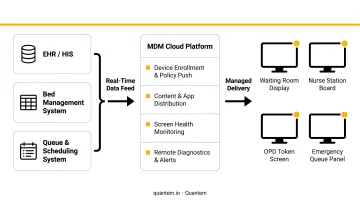
Hospital wayfinding deployments typically involve 50 to 300+ devices that need remote management, kiosk lockdown, and over-the-air updates - none of which a CMS alone handles. Most buyers don't discover this gap until screens are already installed.
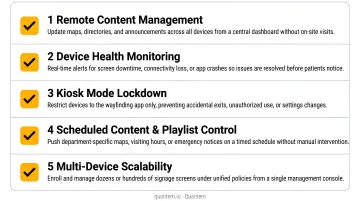
A purpose-built MDM platform fills that device management layer. Quantem - a cloud-based MDM platform with healthcare clients including ATHMA Hospitals - supports:
- Zero-touch provisioning across all pricing tiers, so new kiosks enroll and configure automatically
- Kiosk mode lockdown with progressive tiers (Essential, Professional, and Enterprise Kiosk Pro Settings) to prevent unauthorized access beyond the wayfinding application
- Secure browsing policies that restrict device access to approved content only
- Online/offline status monitoring with sync intervals as fast as 2 minutes, plus battery and offline alerts
- Geofencing and location tracking (Professional and Enterprise plans) for multi-building campus visibility
- Pricing from $1/device/month - 50–70% below typical MDM market rates
For hospital IT teams, this means fewer on-site dispatches, predictable costs, and a single console to manage every screen across every building.
Conclusion
The right hospital wayfinding system directly affects how quickly patients reach their appointments, how much clinical staff time gets absorbed by direction-giving, and how a facility scores on patient satisfaction. The vendors that win long-term evaluations aren't the most recognized names - they're the ones built specifically for healthcare environments.
Before finalizing any vendor decision, evaluate:
- Whether the system can scale as the campus expands or new facilities are acquired
- What the vendor's actual SLA covers - and what the recovery process looks like when screens go dark
- Full cost of ownership across hardware, CMS licensing, installation, content operations, and device management
For hospital networks managing kiosk fleets at scale, the CMS is only part of the equation. The device management layer (remote control, kiosk lockdown, zero-touch provisioning, and real-time monitoring) determines whether every screen stays live and compliant between IT visits.
Explore how Quantem's MDM platform can serve as that management layer for your wayfinding fleet. Visit quantem.io or reach out at sales@quantem.io to learn more.
Frequently Asked Questions
What is the best operating system for hospital digital signage?
Android is the most common choice for hospital kiosks - broad hardware compatibility and native kiosk lockdown via Android Enterprise make it practical for most deployments. Windows fits environments with existing Windows-based IT infrastructure, while purpose-built platforms like BrightSignOS prioritize reliability with built-in device management. Your CMS platform's OS requirements and MDM infrastructure should drive the final call.
What are the digital signage trends for 2026?
Key trends include AI-assisted content personalization, real-time integration with hospital scheduling and patient flow systems, mobile-linked navigation via QR codes for turn-by-turn handoffs to patient smartphones, and centralized cloud CMS platforms for managing large multi-facility display fleets. The US Access Board's updated kiosk accessibility guidelines - expected to finalize in 2025–2026 - are also pushing hospitals to accelerate ADA-compliant interactive kiosk deployments.
What features should hospital wayfinding digital signage include?
Must-have features: interactive indoor maps with step-by-step routing, real-time CMS updates for department changes, multilingual support, ADA accessibility compliance (screen reader, voice guidance, high-contrast modes, one-handed operability), emergency CAP alert integration, and compatibility with hospital scheduling or patient flow data systems.
How much does digital signage for hospital wayfinding cost?
Hardware ranges from roughly $560 for a countertop touchscreen to $20,000 for a fully custom interactive kiosk enclosure. Software varies widely - Rise Vision at $119/display/year and NoviSign from $14/screen/month are transparent-priced, while Omnivex and Skykit are quote-based. Factor in installation, CMS licensing, content operations, and device management when calculating total cost of ownership.
How do hospitals manage large networks of digital signage devices?
Managing 50–300+ kiosks requires an MDM platform with remote monitoring, kiosk mode lockdown, over-the-air policy updates, and zero-touch provisioning - removing the need for on-site IT visits per device. Quantem handles exactly this layer: fleet-wide device management that keeps hospital screens live and locked down across multi-building campuses.
Is digital signage for hospital wayfinding ADA compliant?
Leading wayfinding platforms include screen reader compatibility, tactile button support, voice-guided navigation, high-contrast modes, and adjustable text sizing. Section 508 standards apply to kiosk software in covered US healthcare facilities - request specific ADA compliance documentation and certifications from each vendor before purchasing.