Introduction
Hospital IT teams have never managed more devices. Tablets at nursing stations, barcode scanners in pharmacies, point-of-care computers on every floor, BYOD phones carried by home health workers - the fleet has grown in both scale and complexity.
The CHIME 2024 National Trends Report noted an 11% increase in alerts from mobile health devices and 63% adoption of voice-activated devices in clinical settings. Mobile technology is now inseparable from care delivery.
The pressure on IT teams is acute. Enroll faster. Secure better. Meet tightening compliance requirements. Do all of this with the same headcount and budget. And do it knowing that a single compromised endpoint or extended outage can directly harm patients.
This article covers six of the most pressing device management challenges healthcare organizations face in 2026, and what a modern approach looks like for each one.
Key Takeaways
- Zero-touch enrollment can cut device setup from hours to under 10 minutes
- Healthcare averaged $7.42M per breach in 2025 - the costliest industry for the 14th straight year
- BYOD risks require work profile separation, not blanket bans
- Proposed HIPAA Security Rule updates would mandate technology asset inventories and encryption controls
- Windows 10's end-of-support (October 2025) left many hospital endpoints without security patches
- Over-the-air MDM is now a baseline requirement, not a premium feature
The Scale Problem: Managing Hundreds of Devices Across Multiple Facilities
The Manual Provisioning Trap
Clinical staff now rely on mobile devices for patient documentation, medication administration, lab result retrieval, and real-time communication. For many hospital networks, that means managing hundreds - sometimes thousands - of endpoints spread across departments, floors, and remote sites.
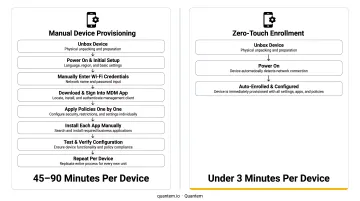
Without automated enrollment, every new device requires an IT administrator to manually configure apps, apply policies, and verify compliance before handing it off. According to Forrester's 2025 Total Economic Impact study of ChromeOS, reimaging or rebuilding a non-cloud-managed device can take 1 to 2 hours, while zero-touch workflows can have users up and running in under 10 minutes. At any meaningful fleet scale, that gap becomes unsustainable.
The Visibility Gap
When devices span multiple locations, IT teams frequently lose situational awareness. A 2026 HIMSS Market Insights survey found that poor device visibility was a major concern for 30% of health systems and a moderate-to-major concern for 56% - with 52% lacking continuous monitoring for lateral movement and segmentation failures.
Without a single consolidated view, IT teams can't reliably answer basic questions:
- Which devices are currently offline?
- Which apps are running on which endpoints?
- Which devices have drifted out of policy compliance?
Multi-OS Complexity
Healthcare fleets rarely run a single operating system. Android devices - tablets, ruggedized scanners - coexist with Windows workstations and kiosks. Managing separate policy frameworks across both OS environments adds significant complexity, particularly when policy updates need to roll out quickly across the entire fleet.
Platforms like Quantem address this through a single unified console that manages both Android Enterprise and Windows MDM devices. IT teams can apply group-based policies, push app updates, and monitor compliance across all device types without switching between separate management interfaces. Zero-touch provisioning is included across all plans, removing the manual setup burden from the start.
Cybersecurity Threats: Why Healthcare Devices Are Prime Targets in 2026
The Cost of a Healthcare Breach - and Why Attackers Keep Coming
Healthcare has been the most expensive sector for data breaches for 14 consecutive years. IBM's 2025 Cost of a Data Breach Report puts the average healthcare breach cost at $7.42 million - and breaches take an average of 279 days to identify and contain. That's nine months of active exposure, often affecting patient records and clinical systems the entire time.
The attack volume is accelerating, too. According to the American Hospital Association, citing FBI data, healthcare was the top ransomware target in 2025 with 460 ransomware attacks and 182 data breaches - totaling 642 cyber events in a single year.
The "Digital Darkness" Risk
ECRI ranked "Unpreparedness for a digital darkness event" as the #2 health technology hazard for 2026 - referring to sudden, complete loss of access to electronic systems, whether from a cyberattack, vendor outage, or internal failure. When EHR systems go dark, clinical staff can't access medication records, lab results, or care plans. Device management must include defined downtime procedures and offline access protocols so care delivery can continue during an outage. Many of those outages begin at the device level - through the same endpoint vulnerabilities that make healthcare a prime ransomware target.
The Endpoint Attack Surface
Every enrolled device is a potential entry point. Common vulnerabilities include:
- Outdated OS versions that haven't received security patches
- Unmanaged apps installed outside IT-approved channels
- Shared login credentials on shared clinical devices
- Unencrypted storage on devices containing or accessing ePHI
- Misconfigured device policies due to manual management errors
What Effective Device-Level Security Looks Like
An MDM platform built for healthcare addresses these risks through:
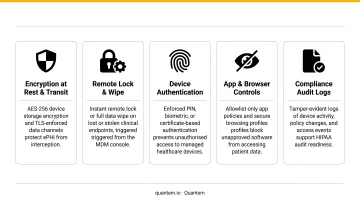
- Remote lock and wipe - immediate response to lost or stolen devices - cuts off ePHI access within seconds of a device going missing
- App whitelisting - only approved clinical apps can run - blocks unauthorized software before it reaches the device
- Encrypted data in transit and at rest - protecting ePHI at the device layer
- Real-time compliance alerts - flags policy violations the moment they occur, before they become incidents
- Compliance certifications - Quantem holds SOC-2, GDPR, and CCPA certifications, providing auditable, verified security controls across all plans
BYOD in Healthcare: Balancing Access and Patient Data Security
Clinicians and home health workers increasingly use personal smartphones for work - accessing patient records, sending clinical messages, or photographing wound sites. When professional and personal data share the same device, PHI exposure risk rises sharply.
Why Blanket Bans Don't Work
Prohibiting personal device use rarely holds in practice - especially for distributed care teams and home health agencies where personal devices are often the only available tools. Organizations need a clear, enforceable framework that enables flexible access without leaving PHI unprotected.
Work Profile Separation
The most practical solution is work profile separation: a managed work container is created on the personal device that isolates all work apps and data from personal apps. PHI never touches the personal partition, and IT can remotely wipe the work container without affecting the employee's personal photos, contacts, or apps.
Quantem supports this BYOD model across its plans, including Android Enterprise Work Profile on the Essential plan. This gives healthcare organizations a practical way to enable BYOD securely, even for teams that aren't ready to invest in dedicated clinical devices for every user.
Policy Enforcement Matters as Much as Technology
Even the right architecture fails without persistent enforcement. The most common breakdown points aren't technical - they're behavioral:
- Staff disabling MDM profiles after enrollment
- Installing unauthorized apps that fall outside IT policy
- Sharing enrolled devices between employees
MDM platforms must detect and alert on compliance drift automatically - not rely on periodic manual audits to catch problems.
Compliance Complexity: Keeping Pace with HIPAA and Evolving Mandates
The Regulatory Landscape Is Changing
Healthcare IT teams have always faced HIPAA Security Rule requirements for ePHI protection - covering access controls, audit controls, transmission security, and device disposal. The bar is now moving higher.
On December 27, 2024, HHS OCR issued a proposed rule to strengthen the HIPAA Security Rule. Published in the Federal Register on January 6, 2025, the proposed updates would add explicit requirements for:
- Technology asset inventories and network maps showing ePHI movement
- Encryption of ePHI at rest and in transit
- Multi-factor authentication
- Vulnerability scanning, penetration testing, and patch management
- Anti-malware controls
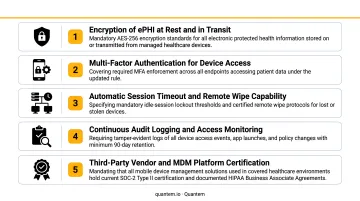
These aren't new concepts. The difference is that the proposed rule would convert them from addressable safeguards into explicit, mandatory requirements - a meaningful shift for any device management program operating under HIPAA.
The Audit Readiness Problem
OCR reported 663 breaches affecting 500+ individuals in 2024, impacting roughly 242 million people - with 81% attributed to hacking or IT incidents. Despite this volume, OCR initiated zero audits in 2024 due to resource constraints. When audits do happen, organizations that rely on manually maintained logs and scattered policy records face weeks of scrambling to produce evidence.
What Compliance-Ready MDM Looks Like
The right MDM platform closes the gap between current practice and where these proposed mandates are heading. Look for:
- Automated policy enforcement without scripting
- Scheduled compliance reports exportable from the console
- App version control to enforce minimum patch levels
- Platform-level certifications - SOC-2 compliance (held by providers like Quantem) confirms the management layer itself meets independent security standards
- Audit-ready logs available on demand, not assembled after the fact
Legacy Device Risk: The Hidden Vulnerability in Healthcare Networks
ECRI ranked "Cybersecurity Risks from Legacy Medical Devices" among its top 10 health technology hazards for 2026. The timing isn't coincidental: Microsoft ended Windows 10 support on October 14, 2025, meaning any hospital workstation or administrative device still running Windows 10 no longer receives security patches. Attackers actively scan for and exploit known vulnerabilities in end-of-life systems.
The Replacement Challenge
Rip-and-replace is expensive and operationally disruptive, particularly for clinical devices integrated into specific workflows. IT teams must often manage a mixed fleet of modern and legacy devices simultaneously, which creates a persistent security gap that can't be closed through software alone.
Mitigation Strategies for IT Teams
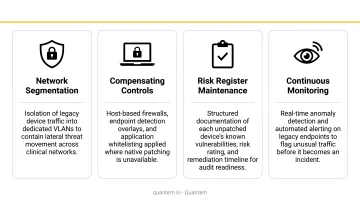
When full replacement isn't immediately feasible, these controls reduce risk:
- Segment legacy devices from systems that handle ePHI to contain potential breaches
- Monitor endpoints for anomalous traffic patterns before unusual behavior escalates
- Maintain an accurate, current inventory of every device and its OS version - you can't protect what you can't see
- Prioritize replacement procurement for the highest-risk devices ahead of the next audit cycle
Remote and Connected Care: Managing Devices Beyond the Hospital Walls
About 2.7 million Medicare fee-for-service beneficiaries received home health care in 2024, with Medicare spending $16 billion on home health services that year. As home healthcare agencies and telehealth models expand, clinical staff and patients use managed devices entirely outside the controlled hospital network - on home Wi-Fi, public networks, or cellular connections.
Over-the-Air Management Is Now a Baseline Requirement
IT teams can no longer assume devices will return to a facility for updates or policy changes. The minimum viable capability set for remote care device management includes:
- Pushing app updates to devices on any network
- Enforcing policy changes without requiring VPN or on-site access
- Remotely wiping lost or stolen devices regardless of location
- Geofencing to detect and respond when devices move outside expected boundaries
For home health worker fleets, geofencing closes a real compliance gap. Platforms like Quantem sync device location every 5 minutes and trigger automated responses - lock, alarm, or password reset - when a device leaves a defined zone. That kind of automated enforcement removes reliance on staff self-reporting, which rarely holds up at scale across dozens of distributed workers.
Any organization running devices beyond a single facility needs this capability in place. Without it, remote enforcement gaps compound quickly - a lost device in the field is a compliance incident waiting to happen.
Frequently Asked Questions
What are the biggest device management challenges facing healthcare organizations in 2026?
The primary challenges are managing large, diverse device fleets across multiple facilities, defending against ransomware and data breaches targeting clinical endpoints, securing BYOD devices that access patient data, meeting HIPAA compliance requirements, and managing the security risk posed by legacy devices running unsupported operating systems.
How can healthcare IT teams manage BYOD risks without compromising patient data security?
Quantem's work profile separation model creates a managed container on a personal device that isolates work apps and PHI from personal apps. IT can remotely wipe the work container without touching personal data, and policy controls apply only to the work partition - leaving the rest of the device untouched.
Why is legacy medical device cybersecurity a top concern for hospitals in 2026?
Legacy devices running unsupported OS versions - including Windows 10, which lost support in October 2025 - no longer receive security patches, making them exploitable targets for ransomware. Mitigation requires network segmentation, active monitoring for anomalous behavior, and accelerated replacement planning for the highest-risk endpoints.
What is zero-touch provisioning, and why does it matter for healthcare IT teams?
Zero-touch provisioning allows new devices to automatically enroll into an MDM platform and receive the correct apps and policies upon first power-on - no manual setup required. Industry data suggests this approach cuts deployment time from 1–2 hours per device to under 10 minutes, enabling IT teams to scale device fleets without proportionally growing headcount.
How does MDM software help hospitals maintain HIPAA compliance?
MDM platforms enforce access controls, manage app versions, maintain compliance logs, enable remote wipe for lost or stolen devices, and support the proposed HIPAA Security Rule requirements for asset inventories and encryption - automating device-level safeguards that would otherwise require manual enforcement.
How can healthcare organizations prepare for device-related "digital darkness" events?
Preparation requires defined downtime procedures, offline access protocols for critical clinical apps, reliable device backup processes, and regular drills. MDM platforms should be configured to maintain care continuity during outages - ensuring staff can access essential information when primary systems go offline.