Enterprise mobility solutions are regularly discussed in terms of feature lists. The more useful conversation is about what they actually change: how fast IT teams deploy devices, how consistently employees stay productive across locations, and how reliably businesses maintain compliance as their fleet scales.
This article focuses on the practical, measurable reasons enterprise mobility management matters for day-to-day workplace operations—not just what it promises on paper.
TL;DR
- Enterprise mobility solutions give IT teams centralized control over every device employees use, whether company-owned or personal (BYOD).
- The real advantages are operational: faster deployment, less device downtime, stronger security, and consistent productivity across locations.
- Without a formal mobility strategy, IT costs, security gaps, and productivity losses all grow in proportion to your device fleet.
- The right platform gives IT teams automation and real-time visibility so device management stays proactive, not reactive.
- Scalable mobility management pays off most when policies are standardized across the fleet from day one.
What Is Enterprise Mobility Management?
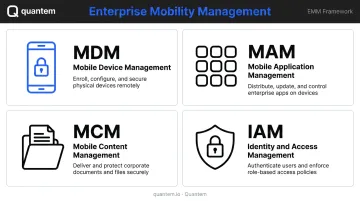
Enterprise mobility management (EMM) is a set of tools and policies that allow IT teams to deploy, configure, secure, and monitor mobile devices and the business applications on them—from a single platform, regardless of where those devices are located.
TechTarget defines EMM as software that lets organizations securely enable employee use of mobile devices and applications, mapping its core components to:
- MDM (Mobile Device Management) — device-level control: enrollment, settings, remote wipe
- MAM (Mobile Application Management) — app-level management and distribution
- MCM (Mobile Content Management) — secure access to business content
- IAM (Identity and Access Management) — user access controls and authentication
For most IT teams, EMM's practical value comes down to centralized device oversight and automated policy enforcement at scale. That combination means IT can maintain consistent security standards across hundreds or thousands of devices without manually touching each one — which matters most when employees are distributed, using personal devices, or working across multiple sites.
Key Advantages of Enterprise Mobility Solutions
The advantages below directly affect the metrics IT leaders, operations managers, and business owners track: deployment time, device downtime, IT workload, security incidents, and workforce productivity. Their impact scales with fleet size — the more devices you manage, the more visible the difference.
Advantage 1: Centralized Device Control and IT Efficiency
Manual device management doesn't scale. Each device provisioned individually, each policy updated by hand, each support request handled reactively—the labor cost compounds quickly as fleets grow.
Enterprise mobility solutions address this by giving IT a single console to deploy, configure, monitor, and manage every device in the fleet. Three capabilities make this practical:
- Zero-touch enrollment — devices can be configured and shipped directly to employees, ready to use out of the box, without IT physically handling them
- Automated policy enforcement — devices stay compliant without manual intervention on each one
- Remote troubleshooting — IT can diagnose and resolve device issues without an in-person visit
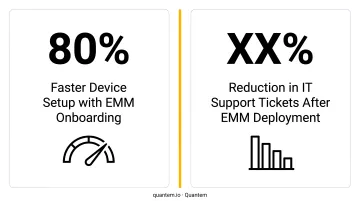
A 2024 Forrester Total Economic Impact study of Microsoft Intune found that automated UEM reduced new-device setup from 2–3 hours to under 30 minutes (80% faster onboarding) and cut endpoint-related help desk tickets by 25%. One organization dropped from 25,000–30,000 tickets per month to 20,000–22,000, with resolution times improving 30% overall.
Platforms like Quantem enable zero-touch provisioning and toggle-based policy management across Android and Windows devices, eliminating the scripting requirements that typically slow IT teams down and increase the risk of configuration errors.
KPIs impacted: device deployment time, IT ticket volume, time-to-resolve device issues, per-device management cost, IT staff hours saved per month.
When this matters most: organizations managing 50+ devices across multiple sites, field teams, or patient-care environments—where inconsistent configuration or reactive support creates visible operational drag.
Advantage 2: Workforce Productivity and Flexible Work Enablement
Device failures and access delays are direct productivity killers. In field service, healthcare, logistics, and retail, an employee who loses device access mid-shift doesn't just lose personal productivity—they create downstream delays that ripple through customer service and operational throughput.
Keeping workers connected requires reliable access to tools, apps, and data from any device, at any location. That's what enterprise mobility solutions deliver:
- Secure remote access to business applications
- Streamlined app deployment to employee devices
- Consistent device performance monitoring that catches issues proactively
- Work profile separation for BYOD environments, keeping corporate data in a secure container without touching personal content
The scale of the risk is significant. Tangoe, citing Vanson Bourne research across 300 IT decision-makers, found that organizations could lose more than 30% of annual revenue without working mobile assets, with downtime costing as much as $4 million per hour for larger enterprises.
The dependency runs deep. An Oxford Economics survey of 500 executives found that 79% said employees cannot do their jobs effectively without mobile phones—and 61% expected remote availability even without a company-issued device.
For BYOD environments specifically, Quantem's work profile separation keeps corporate apps and data in a secure container without touching employees' personal data—making BYOD practical from both an IT and employee perspective.
KPIs impacted: unplanned device downtime hours, time-to-access corporate applications, employee onboarding time, BYOD adoption rate, field worker task completion rate.
When this matters most: distributed or deskless workforces—field service teams, clinical staff, warehouse operators, retail associates—where device accessibility is directly tied to performing core job functions.
Advantage 3: Security and Compliance Without Operational Friction
Mobile devices are a primary attack surface. Verizon's 2025 Mobile Security Index found that 85% of organizations saw increased mobile device attacks—a trend that shows no sign of reversing. Lost or stolen devices carrying unencrypted data add a second layer of exposure, triggering some of the largest regulatory penalties in recent years. HHS OCR records show the University of Rochester Medical Center paid $3 million after an unencrypted flash drive loss and laptop theft. Concentra Health Services paid $1,725,220 in a separate stolen-laptop HIPAA settlement.
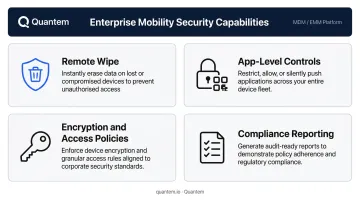
Enterprise mobility solutions enforce security without requiring employees to navigate complex processes:
- Remote wipe protects data on lost or stolen devices immediately
- App-level controls prevent unauthorized data sharing
- Encryption and access policies are enforced automatically, not left to individual compliance
- Compliance reporting provides audit-ready documentation for HIPAA, GDPR, and CCPA requirements
Quantem holds SOC-2, GDPR, and CCPA certifications, and its scheduled custom reporting (up to 50 scheduled reports on Enterprise plans) supports the recurring compliance documentation that regulated industries require.
KPIs impacted: policy violations per quarter, mean time to contain a security incident, compliance audit pass rate, remote wipe execution success rate, breach remediation cost avoidance.
When this matters most: regulated industries (healthcare, finance, education) and any organization running BYOD programs, where personal device misuse creating corporate data exposure is a structural risk.
What Happens When Enterprise Mobility Is Missing
Organizations without a formal enterprise mobility strategy don't eliminate the management challenge. They absorb it informally—through reactive IT support, inconsistent device behavior, and accumulating risk.
The common consequences:
- Manual device management drains IT time. Teams spend disproportionate hours on troubleshooting and configuration instead of infrastructure or strategic work. Zebra's mobile TCO research puts routine IT overhead at $432–$680 per device per year, with individual incidents averaging 70 minutes of IT time each.
- Security gaps accumulate undetected. Unmanaged devices, unchecked app installations, and inconsistent patch updates create vulnerabilities that are difficult to detect before they're expensive to remediate.
- Compliance exposure grows without visibility. Organizations operating under GDPR, HIPAA, or CCPA requirements may not know they have violations until an audit or incident forces the issue—by which point penalties are already in play.
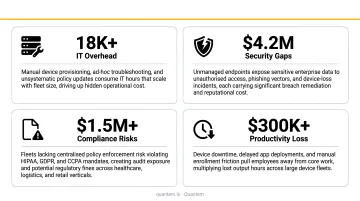
The cost of inaction scales directly with fleet size. Managing 20 devices informally is workable. At 200 devices, the same informal approach produces security gaps, compliance failures, and IT overhead that compound faster than any team can contain manually.
How to Get the Most Value from Enterprise Mobility Solutions
Enterprise mobility solutions deliver compounding value — but only when treated as an ongoing operational practice. Most organizations that underuse their EMM platform share a common pattern: deployment was thorough, but the follow-through wasn't. Three conditions determine whether that value actually materializes:
1. Consistent application Policies, app configurations, and security controls should be enforced uniformly across all devices—not selectively applied to some teams but not others. Inconsistency is where most operational gaps and security risks originate.
2. Regular outcome reviews IT teams should review device performance data, compliance reports, and incident logs monthly or quarterly to identify waste, emerging risks, and optimization opportunities. Quantem's built-in analytics support this kind of recurring visibility:
- Real-time device status monitoring (2-minute sync on Enterprise plans)
- Event feeds and activity logs (up to 30-day retention)
- Up to 50 scheduled custom reports on Enterprise plans
- Event-based alerts for proactive issue detection
3. Acting on the data Organizations that extract the most from enterprise mobility solutions use device analytics to drive real decisions:
- Adjusting data plans based on actual usage patterns
- Consolidating underused apps to reduce licensing costs
- Updating policies before incidents occur, not after
- Scaling onboarding processes ahead of headcount growth
Conclusion
Enterprise mobility solutions matter for workplace management because they deliver control, visibility, and consistency across the one resource modern work depends on most: the devices employees use to do their jobs.
The advantages compound over time. Centralized IT control reduces cost and workload. Productivity enablement keeps distributed teams functional. Security enforcement protects the business from risks that grow in direct proportion to fleet size.
Enterprise mobility management works best as a continuous operational practice—reviewed, refined, and scaled as the organization grows. IT teams that treat it this way spend less time fighting fires and more time supporting the business goals that actually matter.
If you're evaluating platforms, Quantem offers a 21-day free trial with full feature access and no credit card required—a straightforward way to see what modern device management looks like in practice.
Frequently Asked Questions
What is enterprise mobility management?
Enterprise mobility management is the combination of tools, policies, and processes used to securely manage mobile devices, applications, and data across an organization. It covers both company-owned and employee-owned devices from a centralized platform, giving IT teams control over enrollment, security, app distribution, and compliance.
What is the new name for enterprise mobility?
While "enterprise mobility management" (EMM) remains widely used, the broader category is now referred to as Unified Endpoint Management (UEM). UEM extends coverage to laptops, desktops, and IoT endpoints under one framework. Forrester identifies UEM as the successor to both EMM and MDM.
How does EMM differ from MDM?
MDM (Mobile Device Management) is a component of EMM focused specifically on device-level control—settings, enrollment, and remote wipe. EMM encompasses a broader strategy that also includes application management, content security, and identity access management, all aligned to overall business policy rather than just device-level settings.
What are the security risks of not having enterprise mobility management?
Without EMM, lost or stolen devices can't be remotely wiped, inconsistent patch updates leave vulnerabilities open, and employees may expose corporate data through unsecured apps or networks. HIPAA settlements like URMC's $3M penalty for unencrypted laptop theft illustrate the regulatory cost of those gaps.
Can small businesses benefit from enterprise mobility solutions?
Yes. Platforms with flexible per-device pricing and zero-touch enrollment make enterprise mobility practical for smaller IT teams. Quantem, for example, starts at $1 per device per month with no credit card required for a 21-day trial, making it accessible for organizations managing modest fleets with the same security and efficiency available to larger enterprises.
How does BYOD affect enterprise mobility management?
BYOD increases complexity by introducing personal device variability, but EMM platforms address this through work profile separation—keeping corporate apps and data in a secure container without accessing personal content. This makes BYOD programs both practical for employees and policy-compliant for IT.