"Automation" gets cited as the fix. But the word is abstract. What matters for MSSPs is what automation actually prevents: a skipped security baseline, a compliance gap that surfaces during an audit, an onboarding backlog that delays time-to-revenue on a new contract.
This article breaks down the specific, measurable ways automated device provisioning reduces risk for MSSPs - not in theory, but in operational terms that show up in security incident rates, audit readiness, and the ability to scale without adding headcount proportionally.
Key Takeaways
- Automated provisioning removes human variability from device configuration, replacing manual steps with repeatable, policy-driven deployment.
- The three highest-impact risk areas it addresses: misconfiguration, compliance exposure, and onboarding scalability.
- Zero-touch provisioning lets devices self-configure on first power-on - no on-site IT required.
- Manual provisioning at MSSP scale produces inconsistent device states, reactive support cycles, and growing compliance liability.
- Value compounds when provisioning templates are actively maintained and integrated with identity management.
What Is Automated Device Provisioning?
Automated device provisioning is the process of configuring devices using predefined rules and software - no manual setup per device. That includes assigning identities, applying security policies, and setting access permissions.
For MSSPs, that means onboarding and managing devices across multiple client organizations simultaneously. Each client's fleet gets its specific security and compliance requirements applied from the moment a device powers on, without a technician touching it manually.
This isn't primarily an IT efficiency tool. It's a risk management tool. In a multi-client MSSP model, a single device that enters an environment unconfigured or outside policy creates exposure that ripples across the entire client relationship. Automated provisioning closes that gap by enforcing:
- Identity assignment before the device reaches the end user
- Policy application tied to each client's specific compliance requirements
- Access controls that prevent unauthorized use from day one
Key Advantages of Automated Device Provisioning for MSSPs
Each advantage below addresses a specific accountability MSSPs carry - in security posture, compliance standing, and client growth - and maps to measurable operational outcomes.
Advantage 1: Eliminating Misconfiguration Risk Across Client Environments
Manual provisioning across dozens or hundreds of client devices multiplies the chance of a missed setting, incorrect permission, or skipped security baseline. The 2024 Verizon Data Breach Investigations Report found the human element was a component of 68% of breaches, with breaches involving errors growing to 28% of the dataset.
Automation removes that variability. Every device provisioned through a defined template receives identical configuration - regardless of who deploys it, when, or at which client site.
Why this matters for MSSPs specifically:
- A misconfiguration at one client site creates liability exposure, potential SLA breach, and reputational damage
- Automation makes provisioning auditable and repeatable - misconfiguration becomes detectable and preventable rather than a silent risk
- CISA's joint advisory on threats to managed service providers specifically calls out the amplified blast radius when MSPs have inconsistent practices across customer environments
KPIs impacted: Configuration error rate per deployment, mean time to detect misconfiguration, provisioning-related support tickets, security incident rate attributed to device setup.
When this risk is highest: Rapid client onboarding phases, high device volumes, and environments where distributed or junior technicians handle deployments without uniform training.
Advantage 2: Reducing Compliance and Audit Exposure
MSSPs managing regulated clients - in healthcare, finance, or retail - carry shared responsibility for compliance. Every device lacking proper configuration or access controls is a liability under frameworks like GDPR, HIPAA, and CCPA.
Automated provisioning reduces this exposure by applying compliance-aligned configurations at the point of deployment, generating consistent audit logs, and enforcing access policies without relying on technician judgment.
Enforcement cases show the stakes:
- HHS OCR settled a HIPAA ransomware investigation against BST & Co. CPAs - a business associate - for $175,000, citing failure to conduct an accurate risk analysis. Business associates include third-party service providers handling regulated data, which describes many MSSPs.
- ISACA's 2026 privacy study reports technical privacy roles are 47% understaffed - meaning automated evidence collection isn't a convenience, it's a necessity.
- According to Datto's State of the MSP Industry report, 33% of MSPs must adhere to NIST frameworks and 31% to HIPAA - compliance demand isn't niche, it's mainstream.
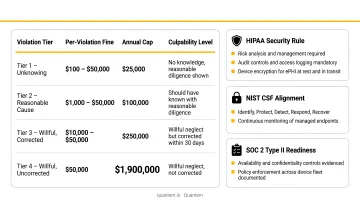
A Forrester study of automated endpoint management found that consistent fleet-wide reporting saved compliance and auditing teams 20 to 30 hours per month. For MSSPs managing compliance across multiple client accounts, that compounds significantly.
KPIs impacted: Compliance coverage rate across provisioned devices, audit preparation time, policy violations detected post-deployment, time to demonstrate compliance to a client or regulator.
Where this obligation intensifies: Clients in regulated industries, upcoming audits, or when the MSSP is expanding into new verticals with stricter data handling obligations. Quantem holds SOC-2, GDPR, and CCPA certifications - relevant when MSSPs need the platform itself to meet regulatory requirements.
Advantage 3: Scaling Client Onboarding Without Scaling Headcount
Managing compliance risk is one constraint on MSSP growth. The other is operational capacity. Manual provisioning creates a hard ceiling: every new device requires technician time, and that time doesn't compress as client count grows - it multiplies.
Zero-touch provisioning breaks this constraint. Devices can be shipped directly to client sites, power on, connect to the network, and self-configure using predefined profiles - no on-site IT presence required.
The numbers are concrete: A Forrester Total Economic Impact study of automated endpoint management found new-device onboarding was 80% faster, reducing setup from 2–3 hours per device to under 30 minutes. Help desk tickets fell 25%, and device-failure triage dropped 75%.
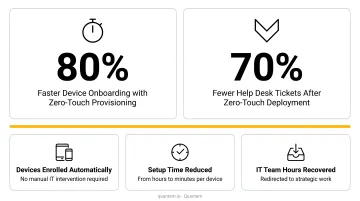
For MSSPs, those reductions translate directly to:
- Faster time-to-revenue on new contracts
- Lower delivery cost per client
- Ability to grow the client base without proportionally growing technical headcount
According to Kaseya's 2024 MSP Benchmark Survey of 984 respondents across 35+ countries, 85% of MSP executives and technicians identify automation as a must-have. Separately, 56% of businesses choose MSPs specifically for help managing hybrid and remote workforces - where remote device deployment without on-site visits is the operational baseline.
Quantem includes zero-touch enrollment across its platform, enabling MSSPs to provision new client devices without scripting expertise or per-device manual setup - using toggle-based policy controls that apply configurations consistently at scale.
KPIs impacted: Time to provision per device, cost per deployment, devices provisioned per technician per day, onboarding-to-live time for new client contracts.
Highest impact scenarios: Rapid client growth phases, large-scale device rollouts across distributed sites, and when MSSPs compete on contract delivery speed.
What Happens When Automated Provisioning Is Missing or Ignored
Manual provisioning at MSSP scale doesn't just slow things down - it creates compounding operational and security debt.
The consequences stack:
- Inconsistent device configurations across client environments create uneven security posture that's difficult to audit and expensive to fix at scale
- Error-prone manual setup drives a reactive support cycle - technicians end up fixing provisioning failures instead of running security operations
- Compliance gaps accumulate quietly: devices provisioned without standardized policy enforcement often don't surface as non-compliant until an audit or incident forces the issue
- Provisioning labor grows in step with client count, eroding margins on managed service contracts
- Patch remediation lags - the Verizon DBIR found it takes approximately 55 days to remediate 50% of critical vulnerabilities once patches are available, with 8% remaining unpatched after a full year
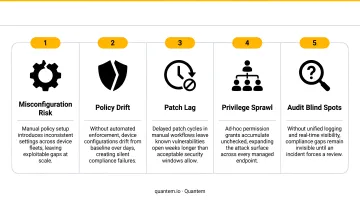
Beyond cost and compliance, there's a structural fragility to consider. MSSPs built on manual provisioning become dependent on specific experienced technicians for every deployment. Staff turnover or rapid growth doesn't just slow things down - it breaks the service.
How to Get the Most Value from Automated Device Provisioning
Automated provisioning reduces risk consistently only when it's applied across the full device lifecycle - not just during initial deployment. Three operational practices determine whether it actually delivers that value:
Keep templates current. Provisioning templates need regular review as client security requirements evolve and regulations change. A template that hasn't been updated in six months applies a six-month-old security baseline across every device it touches.
Monitor provisioning activity centrally. A dashboard that surfaces failure rates, configuration exceptions, and non-compliant devices in real time gives MSSPs the visibility to catch issues before they become incidents. Quantem's fleet-wide management interface uses toggle-based policy controls, making it practical to manage multiple client environments from a single pane of glass - no scripting expertise required.
Treat automation as an ongoing practice, not a one-time setup. Test provisioning workflows after policy changes, review them when new device types are added, and optimize them based on support ticket patterns. The process needs to stay reliable as the client base and device fleet grow.
Conclusion
The value of automated device provisioning for MSSPs sits in three compounding controls:
- Consistency - every device meets the same configuration standard
- Visibility - every configuration is documented and auditable
- Scalability - new client environments come online without proportionally increasing manual effort or risk
These controls directly address the highest-stakes risks MSSPs face - fewer misconfigurations, stronger compliance standing, and faster secure onboarding. Those gains build over time when provisioning is applied systematically and reviewed regularly.
Automated device provisioning is an ongoing operational discipline, not a one-time setup task. MSSPs that treat it that way are better positioned to expand their client base, maintain a strong security posture, and stand out on delivery quality - the kind of differentiation that retains clients long-term.
Frequently Asked Questions
What does device provisioning mean?
Device provisioning is the process of preparing a device for secure use - registering it, applying configurations, assigning access permissions, and verifying its identity before it connects to a network or client environment. For MSSPs, it's the step that determines whether a device enters a client's environment in compliance with security policy.
Which tool is commonly used to automate infrastructure provisioning?
MDM (Mobile Device Management) and UEM (Unified Endpoint Management) platforms are the standard tools for automating device provisioning, handling enrollment, policy assignment, and configuration at scale. For MSSPs specifically, platforms with zero-touch enrollment and multi-client management capabilities - like Quantem - are the most practical choice.
How does automated provisioning reduce security risk for MSSPs?
Automation eliminates the manual configuration steps where human error introduces misconfigurations or skipped security controls. Every device, across every client environment, is set up consistently against a defined security baseline - removing the technician variability that the Verizon DBIR identifies as a component of 68% of breaches.
What is zero-touch provisioning and how does it help MSSPs?
Zero-touch provisioning allows devices to self-configure when first powered on and connected to the internet, without any on-site IT involvement. MSSPs can ship devices directly to remote or distributed client locations, and those devices enroll and apply policies automatically - allowing MSSPs to scale deployments without adding technician headcount.
How does automated device provisioning support compliance requirements?
Automated provisioning enforces compliance-aligned configurations at deployment and generates consistent provisioning records - giving MSSPs documented evidence that devices in regulated client environments meet standards like GDPR, CCPA, or HIPAA when an audit requires it.
What should MSSPs look for in a device provisioning platform?
Key criteria include zero-touch enrollment, centralized multi-client visibility, policy management without scripting requirements, compliance certifications (SOC-2, GDPR, CCPA), and per-device pricing that scales without compressing margins. Quantem checks each of these boxes, with zero-touch enrollment included across all plans and pricing starting at $1 per device per month.