Introduction
Managing 500 devices across a hospital network, warehouse operation, or retail chain sounds manageable - until a misconfigured policy locks out clinical staff mid-shift, or an outdated app version on field scanners triggers a compliance audit. At that point, the question isn't whether you need a dedicated fleet management platform. It's which one can hold up under your operational demands.
Traditional IT management breaks down well before you hit 500 endpoints. Manual provisioning, policy inconsistency across locations, and zero real-time visibility create compounding risks - not just inconvenience.
That pressure is showing up in the numbers. According to Grand View Research, the global MDM market was valued at $7.67 billion in 2024 and is projected to reach $28.37 billion by 2030 - a pace that reflects how urgently enterprises are moving away from ad-hoc device management.
Choosing the right platform matters more than most IT teams realize until something breaks. This guide evaluates five fleet management platforms built specifically for large device networks - Quantem, Microsoft Intune, VMware Workspace ONE, IBM MaaS360, and Hexnode MDM - covering zero-touch enrollment, remote policy enforcement, kiosk controls, BYOD support, and pricing at scale.
Key Takeaways
- Large-scale fleet management requires zero-touch provisioning, OTA policy updates, real-time health monitoring, and RBAC
- Per-device pricing transparency and feature tier depth matter more than headline rates
- Kiosk mode, geofencing, and BYOD work profiles are often gated behind premium tiers - verify before committing
- Quantem offers enterprise-grade MDM at $1–$3/device/month, with core features available across all plans
- Microsoft Intune suits Microsoft-standardized environments best; IBM MaaS360 leads for regulated industries
What Is Fleet Management for Device Networks?
Device fleet management is the centralized IT practice of provisioning, configuring, monitoring, securing, and remotely managing large populations of endpoints - tablets, smartphones, rugged scanners, kiosks, and Windows desktops - from a single admin console.
The challenge shifts at scale. Manual enrollment breaks down past a few hundred devices. Pushing app updates across mixed Android/Windows environments without automation creates version drift - and version drift becomes a compliance gap fast. When auditors ask for the security state of every endpoint at a specific timestamp, "we think most devices are patched" isn't an answer.
Those pressures shaped this review. Each platform was evaluated against the demands of large device networks, not small team deployments, with emphasis on:
- Provisioning speed and automation depth
- Policy consistency across OS types and locations
- Compliance posture across all pricing tiers (not just enterprise add-ons)
- Total cost of ownership at realistic device counts
Best Fleet Management Platforms for Large Device Networks
These platforms were shortlisted based on their ability to scale reliably, support enterprise security requirements, and manage large fleets without adding excessive IT overhead.
Quantem
Quantem is an enterprise-grade MDM platform built for teams managing large fleets of Android and Windows devices, serving healthcare, retail, logistics, and field services. The pricing model is the clearest differentiator: zero-touch provisioning, kiosk mode, and geofencing are available across all plans, not reserved for a premium tier.
Key differentiators:
- Pricing at $1–$3/device/month (50–70% lower than most enterprise MDM tools)
- No hidden fees, no cancellation penalties
- SOC-2, GDPR, and CCPA compliant - audit-ready for regulated industries
- 21-day full-access free trial, no credit card required
- Free migration support on Enterprise plan
| Details | |
|---|---|
| Key Features | Zero-touch enrollment, kiosk mode, BYOD work profile separation, geofencing, private app management with version control, toggle-based policy controls, real-time analytics, API integration |
| Pricing | Essential: $1/device/month · Professional: $2/device/month · Enterprise: $3/device/month (billed yearly); 21-day free trial, no credit card required |
| Best For | Healthcare networks, retail chains, warehouse/logistics operations, field service teams needing enterprise security at significantly lower cost |
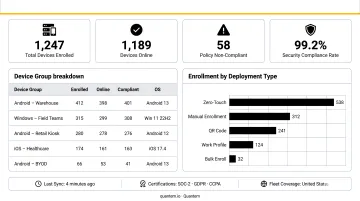
Quantem's platform supports fleets from 10 to 10,000+ devices through a single admin console, with battery and offline status monitoring, event-based alerts on higher tiers, and activity logs that scale by plan. Private app management lets IT teams host internal APKs with version control, supporting up to five app versions on the Enterprise plan - useful for organizations running custom internal applications.
Microsoft Intune
Microsoft Intune is one of the most widely deployed MDM platforms for enterprise Windows environments, with deep integration across the Microsoft 365 and Azure ecosystem. For organizations already standardized on M365 E3 or E5, it's effectively included in what they're already paying.
Why it stands out for Microsoft-centric IT teams:
- Native integration with Microsoft Entra ID for identity-based device compliance
- Windows Autopilot zero-touch enrollment for streamlined Windows device deployment
- Strong app protection policies for BYOD without full device enrollment
- Conditional Access enforcement across Windows, iOS, Android, and macOS
A Forrester Total Economic Impact study found that organizations using Intune achieved 181% ROI, 80% faster new-device onboarding, and 80% reduction in endpoint-update downtime for a composite 30,000-endpoint organization - including one customer that reduced per-device admin time from 3–5 hours down to 5 minutes using Autopilot.
| Details | |
|---|---|
| Key Features | Conditional Access, Windows Autopilot zero-touch enrollment, app protection policies, compliance reporting, Microsoft Defender integration, multi-OS support |
| Pricing | Intune Plan 1: $8/user/month (standalone, billed yearly); included with Microsoft 365 E3 ($36/user/month) and E5 ($57/user/month); Intune Suite: $10/user/month |
| Best For | Enterprises standardized on Microsoft 365, Azure AD, and Windows endpoint fleets |
Intune's per-user pricing (rather than per-device) complicates cost modeling for shared-device environments like retail kiosks or shift-based warehouse operations - worth accounting for before committing.
VMware Workspace ONE (Omnissa)
Following its 2024 spin-off from Broadcom, Workspace ONE now operates under the Omnissa brand. It remains one of the most capable unified endpoint management platforms available, covering mobile devices, desktops, rugged hardware, and shared kiosks in a single platform.
Workspace ONE was named a Leader in the 2026 Gartner Magic Quadrant for UEM Tools and ranked highest across four Critical Capabilities use cases, making it one of the more thoroughly validated options for global-scale deployments.
Differentiators for large enterprises:
- Workspace ONE Intelligence for cross-fleet automation and risk analytics
- Freestyle Orchestrator for no-code workflow automation across devices
- Unified management of traditional desktop environments alongside modern mobile MDM
- DEX (Digital Employee Experience) monitoring
| Details | |
|---|---|
| Key Features | Unified endpoint management (mobile + desktop), Workspace ONE Intelligence analytics, Freestyle Orchestrator, zero-trust access, app lifecycle management, DEX monitoring |
| Pricing | Enterprise Edition: approximately $5.25/device/month or $9.45/user/month; contact Omnissa for full tier pricing |
| Best For | Large global enterprises managing heterogeneous device estates with dedicated IT or endpoint engineering teams |
Workspace ONE's depth comes with a corresponding complexity requirement. This is not a platform for lean IT teams. Organizations with dedicated endpoint engineering resources will get significant value from its automation and analytics layers.
IBM MaaS360
IBM MaaS360 is an AI-driven enterprise MDM platform built on IBM's Watson AI engine. Where it separates from standard MDM tools is security depth: Watson-powered risk scoring assigns device-level threat scores, predictive patch compliance surfaces gaps before audits, and anomaly detection flags behavioral outliers in real time.
For regulated industries, MaaS360 carries real compliance weight: it is FedRAMP and FISMA authorized for government deployments and supports compliance frameworks including HIPAA/HITECH. NIAP lists IBM MaaS360 Cloud Extender version 3.000.800 as a compliant product with a September 2025 certification date.
Where MaaS360 is the right call:
- Organizations where compliance audit trails are non-negotiable
- Government, financial services, or healthcare fleets requiring AI-powered threat detection
- IT teams managing large mixed-OS fleets with strict anomaly detection requirements
| Details | |
|---|---|
| Key Features | Watson AI security analytics, risk-based compliance reporting, unified endpoint security, containerized BYOD (Secure Productivity Suite), patch management, identity and access integration |
| Pricing | Essentials: $4.24/device/month ($50.88/year); higher tiers available via IBM quote |
| Best For | Regulated industries (healthcare, finance, government) requiring AI-powered threat intelligence alongside standard MDM controls |
MaaS360's Watson AI capabilities deliver the most value when security intelligence is the core requirement. Teams focused primarily on provisioning efficiency will find simpler options at lower cost.
Hexnode MDM
Hexnode supports Android, iOS, macOS, Windows, tvOS, and Fire OS - one of the broadest OS coverage sets among mid-market enterprise MDM platforms. That versatility makes it a practical choice for organizations running mixed-device fleets across retail, education, and logistics.
Where Hexnode stands out:
- Clear public pricing with no surprise tier gating for core features
- Strong kiosk lockdown capabilities across Android and other platforms
- Accessible admin console that reduces onboarding time for lean IT teams
- Minimum fleet size of just 15 devices - viable for mid-market buyers
| Details | |
|---|---|
| Key Features | Multi-OS support (Android, iOS, macOS, Windows, Fire OS, tvOS), kiosk lockdown, remote control, app management, location tracking, compliance reporting, conditional email access |
| Pricing | Pro: $2.20/device/month · Enterprise: $3.20/device/month · Ultimate: $4.70/device/month · Ultra: $6.40/device/month |
| Best For | Mid-market to enterprise teams managing multi-OS fleets in retail, education, or logistics wanting broad platform coverage without premium pricing |
Hexnode received an Honorable Mention in the 2026 Gartner Magic Quadrant for Endpoint Management Tools, notable recognition for a platform positioned at mid-market pricing.
How We Chose These Platforms
Platforms were assessed on their ability to support large device network operations - specifically:
- Zero-touch or automated provisioning at scale
- OTA policy and app update reliability
- Real-time fleet visibility across OS types
- Role-based access controls
- Depth of compliance and security controls across all pricing tiers
The most common enterprise buying mistake: evaluating MDM platforms against feature checklists in a demo environment, then discovering that kiosk mode, geofencing, or BYOD work profile separation are locked behind a higher pricing tier than originally quoted. That platform costs $5/device/month for your use case - not $2.
Tie evaluation criteria to business outcomes:
| Capability | Business Impact |
|---|---|
| Zero-touch provisioning | Reduces deployment labor cost at scale |
| Automated compliance reporting | Cuts audit preparation time by reducing manual documentation |
| Real-time device health visibility | Reduces mean-time-to-resolution for field incidents |
| OTA policy enforcement | Eliminates manual intervention for policy updates |
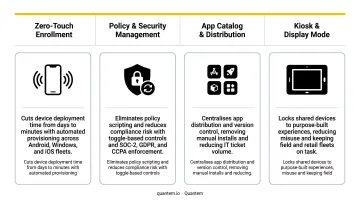
When evaluating platforms, request pricing for your actual device count with every feature your use case requires enabled - that number is your real cost baseline.
Conclusion
For organizations managing large device networks, the right fleet management platform is operational infrastructure - not just an IT tool. Choosing a platform that can provision, secure, and monitor hundreds of endpoints without creating new complexity for IT teams directly affects uptime, compliance, and cost.
Evaluate scalability not just in device count, but in policy flexibility, pricing transparency, and IT overhead as the fleet grows. A low per-device rate means nothing if the platform can't enforce consistent policies at scale without constant manual work.
Teams looking for enterprise-grade MDM at transparent, affordable pricing should explore Quantem. The 21-day full-access free trial requires no credit card, and the Enterprise plan includes free migration support - so you can test it against your fleet's real conditions before committing to anything.
Frequently Asked Questions
What is the best fleet management system?
The best platform depends on your device OS mix, fleet size, and compliance requirements. Microsoft Intune suits Microsoft-heavy environments with existing M365 licensing, while Quantem offers enterprise-grade features at $1–$3/device/month for Android and Windows fleets - a significantly lower per-device cost than most alternatives.
What are the 5 pillars of fleet management?
Device fleet management rests on five core pillars:
- Device provisioning and enrollment
- Policy and configuration management
- Application lifecycle management
- Security and compliance enforcement
- Real-time monitoring and remote control
All five must function at scale for a platform to deliver real operational value.
What is the difference between MDM and device fleet management?
MDM (Mobile Device Management) is the technology layer, meaning the software that communicates with and controls devices. Device fleet management is the broader operational practice of managing large device populations across their full lifecycle, from zero-touch enrollment through decommissioning, including governance, cost, and compliance management.
How many devices can enterprise MDM platforms handle?
Enterprise-grade platforms like Microsoft Intune, VMware Workspace ONE, and Quantem are built to manage tens of thousands of devices. A Forrester Total Economic Impact study on Intune included organizations managing up to 600,000 endpoints. Practical scaling limits depend on admin console performance, policy push architecture, and the platform's infrastructure design.
What should large organizations look for in MDM pricing models?
Check per-device cost at your actual scale, confirm which features are included vs. tier-gated, and factor in migration and implementation labor. A platform priced at $2/device that locks geofencing and kiosk mode to an enterprise tier may cost more in practice than a $3/device option that includes both.
Does MDM support BYOD in large device networks?
Yes. Most enterprise MDM platforms support BYOD through Android Enterprise Work Profile - which separates work apps and data from personal data and allows remote wipe of the work profile without touching personal content. This keeps work data isolated and supports GDPR and CCPA compliance requirements for organizations managing personal devices.