The challenge isn't just scale. Healthcare networks managing hundreds of tablets, logistics companies tracking industrial sensors across multiple countries, and retailers running self-service kiosks all face the same core problem: connectivity alone isn't enough. Devices need to be provisioned, monitored, updated, and secured - from a single place, without requiring a team of scripting experts.
This guide covers the top IoT connectivity platforms for device management, how to evaluate them against your actual deployment needs, and where a dedicated MDM layer fits into the picture for mobile and tablet-based fleets.
Key Takeaways
- The strongest IoT platforms combine connectivity, device management, data handling, and application enablement in a single layer
- AWS, Azure, Balena, Cisco, and Hologram represent the leading options across different deployment architectures
- Security compliance, protocol support, and scalable pricing are the three most underestimated evaluation criteria
- For mobile or tablet-based IoT fleets, an MDM layer like Quantem adds zero-touch enrollment, kiosk controls, and policy automation on top of connectivity platforms
What Are IoT Connectivity Platforms for Device Management?
IoT connectivity platforms are software solutions that enable devices to connect to networks, transmit data, and be remotely managed - covering everything from SIM provisioning and firmware updates to real-time diagnostics. For IT teams evaluating these tools, understanding how the category is structured is the fastest way to avoid buying more (or less) than you need.
The category breaks into four distinct types:
| Platform Type | Primary Function |
|---|---|
| Connectivity Management Platforms (CMPs) | Network access, SIM lifecycle management, carrier routing |
| Device Management Platforms | Provisioning, configuration, OTA updates, diagnostics |
| Data Management Platforms | Data collection, processing, and storage |
| Application Enablement Platforms (AEPs) | Tools to build and deploy IoT applications |
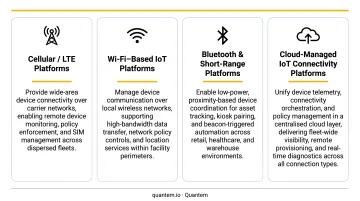
That four-way split rarely maps cleanly to what vendors actually sell. Most enterprise buyers don't need all four separately - modern platforms typically blend two or three layers. AWS IoT Device Management, for example, handles device management and integrates with AWS's data and application services, while Hologram focuses almost entirely on the connectivity layer.
The global IoT platform market is projected to reach $65.29 billion by 2030, growing at an 8.1% CAGR. That growth reflects sustained enterprise adoption across industries, which means the number of available platforms will keep expanding - making a clear evaluation framework more valuable, not less.
Best IoT Connectivity Platforms for Device Management
These five platforms were selected based on reliability, scalability, security capabilities, multi-device support, and deployment flexibility across industries.
AWS IoT Device Management
Part of Amazon's broader IoT ecosystem, AWS IoT Device Management lets enterprises onboard, organize, monitor, and remotely manage device fleets at scale - with native integration into AWS IoT Core and Greengrass.
Three capabilities set it apart from generic device management tools: bulk registration via certificate templates, fleet indexing for grouping and querying devices by attribute or location, and secure tunneling that opens bidirectional access to devices behind firewalls - without changing inbound rules.
| Category | Details |
|---|---|
| Key Features | Bulk device onboarding, fleet indexing, OTA firmware updates, secure tunneling, job scheduling for remote actions |
| Supported Environments | x86_64 and ARM processors running Linux; integrates with AWS IoT Core and Greengrass |
| Pricing Model | Usage-based: $0.10 per 1,000 device registrations; $0.003 per remote action; $1.00 per secure tunnel session |
Best for: Teams already running workloads on AWS who want tight ecosystem integration and pay-per-use cost control.
Microsoft Azure IoT Hub
Azure IoT Hub is Microsoft's managed cloud service for bi-directional device-to-cloud communication, designed for enterprise deployments that need granular identity management and resilient update delivery.
Per-device security credentials and individual access revocation - managed through Azure's identity registry - give security teams precise control over which devices can communicate and when. OTA updates through Device Update for IoT Hub include A/B failover and automatic rollback, critical for fleets where a failed update takes a device offline.
| Category | Details |
|---|---|
| Key Features | Per-device authentication, OTA updates with automatic rollback, device twins for state management, Azure ecosystem integration |
| Supported Environments | AMD64, ARM32v7, ARM64 running Linux (Debian 11/12/13, Ubuntu 20.04/22.04/24.04); Eclipse ThreadX for RTOS devices |
| Pricing Model | Tier-based by IoT Hub unit and daily message volume; free tier includes 8,000 messages/day and up to 500 device identities |
Best for: Organizations already in the Microsoft ecosystem who need enterprise-grade identity management and advanced analytics via Azure Digital Twins.
Balena
Balena is a container-based fleet management platform built around Docker, built for Linux-based embedded devices and edge computing. It supports 80+ device types - including Raspberry Pi, NVIDIA Jetson, and Intel NUC - and runs balenaOS, a minimal Yocto-based operating system optimized for embedded hardware.
The container architecture keeps deployments non-disruptive: updates push to containers rather than the base OS, reducing the risk of bricking remote devices mid-update.
The first 10 devices are always free, making it the most accessible starting point for teams running pilots before scaling.
| Category | Details |
|---|---|
| Key Features | Container-based OTA deployments, balenaOS, multi-architecture support, remote device access, fleet segmentation |
| Supported Environments | ARMv6/v7, ARM64, AMD64; supports Node.js, Python, and Go runtimes |
| Pricing Model | First 10 devices free; Prototype plan starts at $159/month (includes 30 devices, $3/additional device/month) |
Best for: Engineering teams building Linux-based IoT products at the edge who want Docker-native workflows and hardware flexibility.
Cisco IoT Control Center
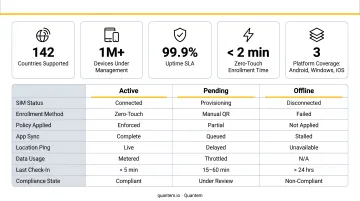
Cisco IoT Control Center is an enterprise-grade connectivity management platform focused on SIM lifecycle management at massive scale - currently supporting over 270 million devices across 60+ service providers and 32,000 enterprises in 120+ countries.
The platform's depth of SIM-level control is its core differentiator. Automated zero-touch provisioning activates thousands of SIMs using rules-based automation, while IoT SAFE applets embedded in SIMs establish TLS connections directly between devices and cloud hubs - removing the device as a security liability during initial connection.
| Category | Details |
|---|---|
| Key Features | Zero-touch provisioning, SIM lifecycle management, IoT SAFE/TLS encrypted communication, centralized telemetry, automated onboarding |
| Supported Environments | Multi-network cellular (2G–5G, LTE-M, NB-IoT); designed for carrier and enterprise deployments at scale |
| Pricing Model | Enterprise contract-based; pricing not publicly listed - contact Cisco directly for a custom quote |
Best for: Large enterprises and communications service providers managing millions of cellular-connected devices across industries like automotive, industrial, and healthcare.
Hologram
Hologram simplifies global cellular connectivity by giving each device a single SIM that automatically switches between 550+ carrier networks across 190+ countries. For organizations managing geographically distributed fleets, that eliminates the complexity of negotiating and monitoring separate carrier SLAs per region.
The platform includes real-time device visibility, a developer REST API for automating SIM activation and monitoring, and Outage Protection with two independent mobile cores that reduce the risk of a single carrier outage taking down fleet connectivity.
| Category | Details |
|---|---|
| Key Features | Automatic carrier switching, global SIM management, real-time visibility dashboard, developer API, data usage monitoring |
| Supported Environments | 4G LTE, LTE-M/Cat-M1, NB-IoT, 5G, automatic 2G/3G fallback; any device accepting a SIM card |
| Pricing Model | $0.03/MB data + $1/month per SIM + $3 per SIM card; custom pooled-data plans available for larger fleets |
Best for: Small-to-mid-sized teams deploying cellular IoT devices across multiple countries who can't manage per-region carrier contracts.
How We Chose the Best IoT Connectivity Platforms
Evaluation Criteria
The most common mistake in platform selection is choosing based on brand recognition rather than architectural fit. A platform optimized for SIM management won't solve firmware update challenges - and vice versa.
The five platforms above were evaluated against these criteria:
- Device lifecycle support - does the platform handle provisioning, OTA updates, diagnostics, and decommissioning, or only part of the lifecycle?
- Security and compliance - encryption standards, access controls, and certifications like SOC-2 and GDPR matter especially for regulated industries
- Scalability - can the platform manage 10 devices today and 10,000 in 18 months without forcing a migration?
- Integration flexibility - open APIs and protocol support (MQTT leads IIoT protocol adoption at 56% according to the Eclipse Foundation's 2024 survey) matter for connecting platforms to existing IT systems
- Pricing transparency - usage-based, flat-subscription, and enterprise-contract models all scale differently; hidden per-action fees can make a "cheap" platform expensive at scale
Where MDM Fits In
The platforms above handle connectivity and device-level management for embedded and cellular-connected hardware. But for organizations running mobile or tablet-based IoT fleets - hospital Android tablets, retail kiosks, field service devices - a dedicated MDM layer adds capabilities these platforms don't provide.
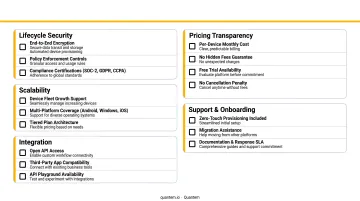
Quantem operates at this layer, priced at $1–$3 per device per month across three tiers. It adds capabilities purpose-built for managed Android fleets:
- Zero-touch enrollment for rapid device provisioning
- Kiosk mode controls for single-app and multi-app deployments
- No-script policy automation via toggle-based configuration
- BYOD work profile separation for secure personal/work boundaries
It's SOC-2, GDPR, and CCPA compliant - which matters when healthcare or retail device fleets carry sensitive patient or payment data. For IT teams managing mixed fleets where some devices are cellular-connected industrial sensors and others are Android tablets used by clinicians or technicians, Quantem and a connectivity platform like AWS IoT or Azure IoT Hub can run in parallel.
Conclusion
The right IoT connectivity platform depends on what your fleet actually looks like. A hospital network managing 500 Android tablets has different priorities than a logistics company tracking industrial sensors across 10 countries - and the same platform rarely serves both well.
Clarifying those priorities starts with an honest gap assessment. Before selecting a platform, audit what your current setup actually lacks:
- Does your platform handle the full device lifecycle, or only connectivity?
- Does it support your hardware architecture and OS?
- Will per-action or per-device pricing stay manageable at 5x your current fleet size?
If your team manages a mobile or tablet-based IoT device fleet and needs an affordable MDM solution with zero-touch enrollment, kiosk mode, and SOC-2, GDPR, and CCPA compliant security, start Quantem's 21-day free trial. No credit card required, no hidden fees, and migration support is included in the Enterprise plan.
Frequently Asked Questions
What are the 4 types of IoT platforms?
The four types are Connectivity Management Platforms (CMPs) for network and SIM management, Device Management Platforms for provisioning and OTA updates, Data Management Platforms for data collection and processing, and Application Enablement Platforms for building IoT applications. Most modern enterprise platforms blend two or three of these layers rather than operating as a single-function tool.
Which IoT platform is best for mobile-based real-time control?
AWS IoT Device Management and Azure IoT Hub handle real-time monitoring well for connected hardware. For mobile device fleets - Android tablets, Windows devices, phones - an MDM platform gives direct control over apps, policies, and configurations from a centralized dashboard, which connectivity platforms alone don't provide.
What is the difference between an IoT connectivity platform and a device management platform?
Connectivity platforms (CMPs) focus on how devices connect to networks - SIM provisioning, carrier management, and data routing. Device management platforms handle the device lifecycle: onboarding, configuration, firmware updates, monitoring, and security policy enforcement. Many modern platforms combine both, but some specialize in one or the other.
What key features should I look for in an IoT connectivity platform?
Prioritize OTA update capability, secure device authentication, real-time monitoring, open API integrations, scalable pricing, and compliance certifications (SOC-2, GDPR). Security and scalability are the two most commonly underestimated criteria. Gaps in either are expensive to fix after deployment.
How much do IoT connectivity platforms typically cost?
Pricing models vary: usage-based (AWS), flat subscription with device scaling (Balena, starting at $159/month), and enterprise contract (Cisco). Per-device and per-action costs accumulate quickly at scale, so verify current pricing directly with vendors - base rates rarely reflect total deployment cost.
Can small and mid-sized businesses use IoT device management platforms?
Yes. Balena's free 10-device plan and Hologram's pay-as-you-go model at $0.03/MB lower the entry barrier for smaller teams. For mobile device fleet management, Quantem runs $1–$3 per device per month - well below legacy enterprise MDM tools that typically start at $3–$10+ per device.