The scale of this shift is significant. According to Grand View Research, the global self-service kiosk market was valued at $34.36 billion in 2024 and is projected to reach $62.46 billion by 2030, growing at a 10.9% CAGR. Not every kiosk in that market is IoT-connected - but the ones delivering real operational value increasingly are.
This guide covers what qualifies a kiosk as an IoT device, the core capabilities IoT unlocks, how different industries are deploying them, the security and compliance requirements operators must address, and how IT teams manage these fleets at scale.
Key Takeaways
- IoT transforms kiosks from standalone terminals into networked devices capable of real-time monitoring, remote management, and data-driven personalization.
- Core IoT capabilities - predictive maintenance, inventory sync, OTA updates, and behavioral analytics - directly reduce downtime and operating costs.
- Healthcare, retail, hospitality, and QSR are seeing the highest adoption and ROI from IoT kiosk deployments.
- Kiosks handling payments or personal data must meet PCI-DSS, HIPAA, GDPR, and CCPA requirements - no exceptions.
- Scaling IoT kiosk fleets requires an MDM platform with zero-touch provisioning, kiosk mode, and remote monitoring built in.
What Makes a Self-Service Kiosk an IoT Device?
Not every kiosk qualifies as an IoT device. A standalone unit running locally-installed software with no network connection is just a dedicated computer - functional, but isolated from the broader data ecosystem that defines IoT.
NIST SP 800-213 defines IoT devices as those with at least one transducer (a sensor or actuator) for interacting with the physical world and at least one network interface. A modern self-service kiosk meets both criteria when properly deployed.
The Hardware Layer That Enables IoT
The sensors and modules embedded in today's kiosks each generate continuous data streams:
- Touchscreens with usage telemetry (tap patterns, session duration, error states)
- Barcode and QR scanners feeding transaction and inventory data
- Payment terminals reporting transaction status and hardware health
- Presence and proximity sensors detecting customer approach and dwell time
- Cameras supporting vision-based item recognition or identity verification
- Environmental sensors monitoring temperature and humidity (critical for hardware longevity)
- Network modules - Wi-Fi, cellular, or Bluetooth - maintaining the connection layer
Traditional vs. IoT-Enabled Kiosks
The operational difference is stark:
| Capability | Traditional Kiosk | IoT-Enabled Kiosk |
|---|---|---|
| Configuration | On-site, manual | Remote, OTA |
| Monitoring | Reactive (wait for failure) | Proactive (real-time alerts) |
| Updates | Technician dispatch | Over-the-air |
| Data collection | None or local only | Continuous, cloud-synced |
| Inventory sync | Manual or batch | Real-time |
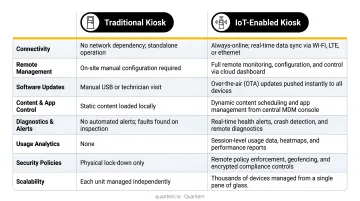
That shift from a passive terminal to a self-reporting endpoint is what unlocks remote management at scale - fewer truck rolls, faster incident response, and operational data that actually informs decisions.
Key IoT Capabilities Powering Modern Self-Service Kiosks
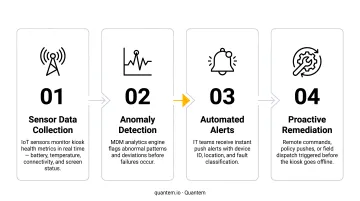
Real-Time Monitoring and Predictive Maintenance
IoT sensors embedded in kiosks continuously track hardware health - printer paper levels, screen responsiveness, payment terminal status, internal temperature - and send alerts to IT or operations teams before a failure causes customer-facing downtime.
Field-service dispatches for self-service terminals typically cost $150–$300 per visit, according to ATM Marketplace. Multiply that across a fleet of 50 or 500 kiosks, and reactive maintenance becomes expensive quickly. The stronger argument for predictive maintenance is avoiding the lost transactions and customer experience damage that comes with unexpected downtime.
Predictive models go further: machine learning analyzes sensor data over time to forecast when a component is likely to fail, so repairs are scheduled proactively instead of triggered by emergencies.
Inventory and Backend System Synchronization
IoT-connected kiosks sync in real time with inventory management or ERP systems, so customers only see what's actually available. Out-of-stock menu items at a QSR kiosk or inaccurate counts at retail self-checkout both erode trust - and both are preventable.
That bidirectional data flow enables:
- Automatic low-stock alerts to operations teams
- Reorder triggers without manual oversight
- Kitchen capacity data feeding QSR order flow management
Personalized Customer Experiences Through Data
IoT kiosks collect and transmit transaction data - items selected, session duration, payment method, time of day - to analytics platforms. That data drives personalized promotions, upsell suggestions, and loyalty program offers during future interactions.
Personalization at the kiosk level increases average order value - and the kiosk handles it without staff involvement. Key data points that fuel this include:
- Session duration: identifies where customers hesitate or disengage
- Payment method: informs targeted offer eligibility
- Time-of-day patterns: enables daypart-specific promotions
Over-the-Air (OTA) Updates and Remote Content Management
IoT connectivity lets operators push software updates, security patches, and content changes - menu updates, promotional screens, UI revisions - to entire fleets simultaneously. No technician dispatches, no per-device manual work.
For operators running kiosks across dozens of locations, this capability alone justifies the IoT investment. Patching a security vulnerability across 200 kiosks in minutes instead of days is a fundamentally different security posture.
Usage Analytics and Business Intelligence
Aggregated IoT data from kiosk fleets feeds business intelligence dashboards. The metrics that matter:
- Transaction volumes by location and time of day
- Peak usage hours for staffing optimization
- Error rates and session abandonment points
- Interface interaction patterns identifying UX friction
Operators who use this data make better decisions about kiosk placement, interface design, and staffing - decisions based on actual usage rather than assumptions.
Industry Use Cases: IoT Kiosks Across Sectors
Healthcare
Patient self-check-in kiosks that connect to EHR/EMR systems can pull appointment data, verify insurance, and update records in real time - reducing administrative burden on front desk staff without requiring patients to repeat information.
The evidence here is strong. A peer-reviewed study published in the Journal of Emergency Medicine found that emergency departments with self-check-in kiosks had 56.8% shorter wait times than EDs without them. That's a meaningful outcome in a setting where wait time directly affects patient satisfaction and care quality.
Healthcare kiosks also include:
- Wayfinding stations with live directory feeds
- Telemedicine-enabled consultation points in underserved locations
- Insurance verification terminals that sync with billing systems in real time
Retail and QSR
Retail self-checkout kiosks use IoT to sync with POS and inventory systems, detect bagging anomalies to reduce shrinkage, and surface personalized promotions. Self-checkout now makes up 38% of grocery checkout options, with U.S. self-checkout lanes increasing 10% over five years, per Retail Dive citing Catalina research.
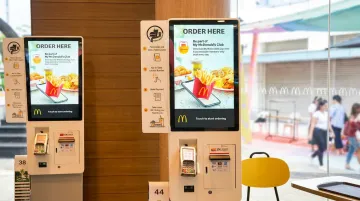
In QSR, IoT kiosks receive live menu updates and kitchen capacity data. When a menu item runs out mid-service, the kiosk adjusts what it offers automatically. Analysts expected McDonald's kiosk remodels to lift sales 5–6% in the first year, according to Business Insider.
Hospitality
Hotel IoT check-in kiosks communicate with property management systems to issue keyless room access, manage loyalty points, and flag room readiness - enabling 24/7 self-service and removing front desk bottlenecks for guests who want to go straight to their room. Oracle research found that 73% of travelers want to use technology to manage their hotel experience, including check-in, check-out, and payments.
Transportation and Public Services
Transit ticketing kiosks sync with live schedules, seat availability, and payment processors to enable real-time pricing and dynamic schedule displays. Major transit authorities including WMATA and BART deploy fare vending machines across every station - the IoT layer makes those systems responsive rather than static.
IoT Kiosk Security and Data Privacy Challenges
Kiosks operate in public, unsupervised environments. They handle sensitive payment data, sometimes personal health information, and they're connected to enterprise networks. That combination makes them attractive attack surfaces.
The most common attack vectors include:
- Intercepting unencrypted data in transit via man-in-the-middle attacks
- Unauthorized physical access to USB ports or internal hardware
- Malware injection through unmanaged app installs
- Kiosk-mode escape vulnerabilities (documented in CVE-2023-51772, where a Chromium-based kiosk mode allowed unauthorized exits)
Compliance Requirements
Which regulations apply depends on what data the kiosk handles:
- PCI-DSS v4.0.1 applies to any kiosk accepting card payments
- HIPAA Security Rule applies when kiosks access, transmit, or store electronic protected health information (ePHI)
- GDPR and CCPA apply to any kiosk collecting personal data from users in covered jurisdictions
The financial stakes are real. IBM's 2025 Cost of a Data Breach Report puts the global average breach cost at $4.44 million - and $7.42 million for healthcare. Non-compliance doesn't just create regulatory exposure; it creates operational liability.
Required Security Controls
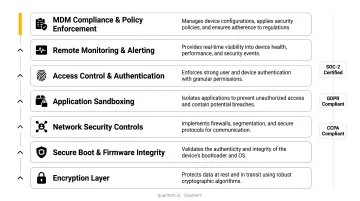
Meeting those standards requires layered controls at every level of the stack. Every IoT kiosk deployment should enforce:
- End-to-end encryption for data in transit (TLS) and at rest (AES-256)
- App whitelisting to prevent unauthorized software execution
- Network segmentation isolating kiosks from core enterprise systems
- SOC-2, GDPR, and CCPA compliant MDM platforms - such as Quantem - that enforce consistent policies across the entire kiosk fleet
- Regular OTA security patches closing vulnerability windows before exploitation
Managing IoT Kiosk Fleets at Scale with MDM
A business with 50 kiosks across 10 locations cannot afford to manage each device manually. Every configuration change, software update, and troubleshooting session that requires an on-site visit eats into the operational efficiency that IoT is supposed to deliver.
Mobile Device Management (MDM) platforms provide centralized, remote control over configuration, policy enforcement, app management, and troubleshooting - without dispatching technicians.
Zero-Touch Provisioning
When a new kiosk is powered on for the first time, zero-touch enrollment automates the entire setup sequence: the device connects to the MDM platform, downloads its configuration profile, installs approved apps, and locks into kiosk mode with no manual IT setup required at the device level.
For large fleet deployments, this scales directly with the size of your rollout. Devices can be drop-shipped directly to locations and provision themselves on first boot. A Forrester TEI study on endpoint management found 80% faster new-device onboarding with modern MDM platforms.
Quantem's MDM platform includes zero-touch enrollment across all plans, supporting fleet deployments from 10 to 10,000 devices.
Kiosk Mode and App Lockdown
Kiosk mode locks a device to a single approved application (or a curated set of apps), preventing users from exiting the interface, accessing device settings, or installing unauthorized software. It's the foundational security and UX control for any IoT self-service deployment.
Without it, a customer or bad actor can exit the kiosk interface and reach the underlying operating system. Quantem includes built-in kiosk mode across all pricing plans, with tiered capabilities from Essential through Enterprise, including Kiosk Pro Settings at the Enterprise tier.
Remote Monitoring and Troubleshooting
An MDM platform provides real-time visibility into every kiosk in the fleet:
- Connectivity and online/offline status
- Battery levels and hardware alerts
- App crash detection
- Event-based alerts for anomalous behavior
When something goes wrong, IT teams can act remotely - rebooting devices, pushing configuration resets, or triggering app restarts - without sending a technician. Forrester's endpoint management research found 75% reduced device-failure triaging with centralized MDM, and 80% reduced endpoint-update downtime.
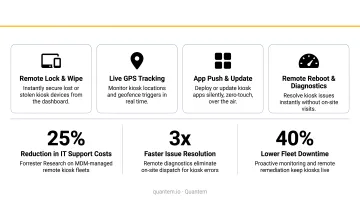
Quantem's platform surfaces online/offline history with 2-minute sync intervals at the Enterprise tier, giving fleet operators near-real-time visibility across distributed deployments.
OTA Policy and App Management
MDM enables IT teams to push app version updates, policy changes, and compliance configurations to all kiosks simultaneously. Version control ensures consistency across locations: no kiosk runs an outdated app version, and no policy gaps open between sites.
Quantem supports private app version control across plans (up to 5 versions at Enterprise), along with 250+ toggle-based policy controls that require no scripting. For operators managing proprietary kiosk applications, this means distributing and updating custom software fleet-wide without developer involvement in each deployment.
For teams evaluating MDM options, Quantem offers a 21-day free trial with no credit card required - covering kiosk mode, remote monitoring, and device management features at full access.
The Future of IoT in Self-Service Kiosks
The next wave of IoT kiosk capability is happening at the intersection of edge computing and AI. Vision AI systems can recognize items, authenticate users via facial recognition, and enable autonomous checkout, processing data locally at the edge for lower latency than cloud-dependent approaches.
Amazon's Just Walk Out technology demonstrates where this trajectory leads: sensors, computer vision, and AI tracking item selection automatically and charging customers upon exit. Amazon reported it would deploy more Just Walk Out stores in 2024 than any previous year, more than doubling third-party locations using the technology. The global computer vision AI in retail market is projected to grow from $1.66 billion in 2024 to $12.56 billion by 2033, per Grand View Research - a 25.4% CAGR that reflects sustained, large-scale capital commitment to the space.
Two connectivity advances are reshaping how fleets get deployed at scale:
- 5G delivers the low-latency, high-bandwidth connections that outdoor and high-traffic kiosk deployments need without relying on fixed network infrastructure
- eUICC (embedded SIM) eliminates physical SIM swaps for multi-region fleets, letting IT teams switch carriers remotely and keep kiosks online regardless of location
Neither technology rewrites the underlying IoT architecture - but together they remove the deployment friction that has historically slowed large-scale rollouts across diverse environments.
Frequently Asked Questions
Is a kiosk an IoT device?
Modern self-service kiosks qualify as IoT devices when they're embedded with sensors, connected to a network, and capable of sending and receiving data with cloud or back-end systems. Not all kiosks meet this definition - legacy standalone units with no network connectivity remain passive terminals rather than active IoT endpoints.
What IoT sensors are commonly used in self-service kiosks?
Common sensors include proximity and presence detectors, touchscreen usage sensors, cameras, barcode and QR scanners, payment terminal sensors, environmental sensors (temperature, humidity), and network connectivity modules. Each feeds data to monitoring, analytics, or operational systems.
How does IoT improve self-service kiosk security?
IoT enables real-time security monitoring, automated anomaly detection, remote app whitelisting, and over-the-air security patch delivery. This reduces vulnerability windows compared to manually updated devices that may go weeks or months without patches.
What is kiosk mode and why does it matter for IoT deployments?
Kiosk mode locks a device to a specific application or approved set of apps, preventing unauthorized access to device settings or outside software. For IoT kiosk deployments in public environments, it's the foundational control for both security and user experience - especially where on-site IT supervision isn't available.
How are large IoT kiosk fleets managed remotely?
MDM platforms handle zero-touch provisioning, remote troubleshooting, OTA updates, and policy enforcement without on-site IT visits. Platforms like Quantem let operators manage fleets of hundreds or thousands of kiosks across multiple locations from a single console.
What industries benefit most from IoT-enabled kiosks?
Healthcare, retail, hospitality, QSR, and transportation are seeing the highest adoption and measurable ROI from IoT kiosk deployments. Use cases range from patient check-in and EHR integration in hospitals to dynamic menu management in QSRs and live schedule sync at transit hubs.