Introduction
In 2026, businesses need more than breadcrumb trails on a map. They need systems that lock devices when they leave secure zones, enforce BYOD policies at job sites, and produce audit-ready location records without manual work.
Geofencing software has moved past simple fleet tracking. It now supports security, compliance, and day-to-day efficiency across distributed teams, devices, and physical assets.
The hard part is cutting through noise. Market estimates diverge wildly, vendors conflate GPS accuracy with operational reliability, and pricing stays opaque. This guide evaluates the best geofencing solutions in 2026 for teams that want real-time visibility, transparent pricing, and flexible deployment—from affordable MDM platforms to enterprise fleet telematics.
Key Takeaways
- Geofencing triggers alerts, policy enforcement, and asset protection when devices or vehicles cross virtual zones
- The 2026 market splits into device-focused MDM platforms and vehicle-focused telematics for fleets
- Quantem offers enterprise device geofencing at $1-3/device/month (50-70% below typical MDM) with SOC-2, GDPR, and CCPA compliance
- Prioritize boundary accuracy, alert customization, location-history retention, APIs, and total cost beyond subscription fees
- Healthcare, field services, logistics, retail, and construction use it for compliance tracking, job-site proof, and loss prevention
Overview of Geofencing Software in 2026
Geofencing software uses GPS, Wi-Fi, or cellular signals to create virtual perimeters around physical locations. When a device or asset enters, exits, or dwells within a defined zone, the system triggers automated actions: alerts, policy changes, device locks, or audit records.
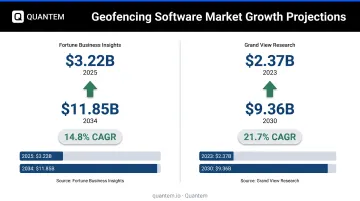
Analyst estimates for 2026 diverge on size and timeline. Fortune Business Insights projects growth from $3.22B in 2025 to $11.85B in 2034 at 14.8% CAGR, while Grand View Research reports $2.37B in 2023 to $9.36B in 2030 at 21.7% CAGR.
Despite those gaps in scope and forecast windows, both point to accelerating demand well beyond traditional fleet tracking.
What's driving adoption?
- Distributed work: 22.6% of U.S. workers teleworked in March 2026 (BLS), so IT must manage devices across homes, customer sites, and temporary job locations
- Regulatory pressure: HIPAA, DOT, and GDPR require audit trails that show where sensitive devices were when incidents occurred
- Theft and loss: Retailers, healthcare facilities, and construction firms are replacing manual check-ins with automated geofence alerts
The following section presents the top geofencing software solutions, evaluated on affordability, ease of deployment, real-time accuracy, multi-platform support, compliance capabilities, and customer feedback across industries.
Best Geofencing Software Solutions
Solutions were chosen based on affordability, ease of deployment, real-time accuracy, multi-platform support, compliance capabilities, and verified customer feedback across healthcare, logistics, retail, field services, and government verticals.
Quantem
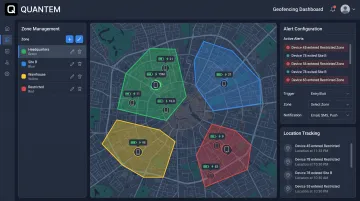
Quantem is a mobile device management (MDM) platform with geofencing for smartphones, tablets, and managed devices. It targets teams that need device-level location tracking, policy enforcement, and BYOD security without heavy MDM complexity or cost.
Key differentiators:
- Pricing 50–70% below typical MDM tools ($1–3 vs. $3–10+ per device)
- SOC-2, GDPR, and CCPA compliance on all plans
- Geofencing from Professional at $2/device/month
- Zero-touch enrollment and a 21-day free trial (no credit card)
- Android and Windows device support
| Attribute | Details |
|---|---|
| Pricing | $1–3/device/month yearly (Essential $1, Professional $2, Enterprise $3); geofencing on Professional+; no setup fees or cancellation penalties |
| Key Geofencing Features | Near-real-time tracking (5-min Professional, 2-min Enterprise); radius zones (km/m/mi); email and console alerts; location history (15–30 days); lock/password/alarm on boundary cross; kiosk and policy automation via REST API |
| Best For | Healthcare device tracking, retail POS and employee devices, field-service BYOD, SMB device geofencing without long contracts, logistics delivery devices |
Geotab
Geotab is a telematics and fleet management platform with geofencing for vehicle tracking, asset monitoring, and compliance automation. It fits mid-to-large fleets that need GPS tracking, regulatory reporting (ELD, DVIR, HOS), and a broad Marketplace of integrations.
Key differentiators:
- GPS fleet tracking with AI-driven analytics
- 250+ Marketplace integrations (vendor materials also cite 350–400+)
- EV energy and charge-status reporting
- Point-defined and square-zone geofences
- DOT-oriented security and compliance for transport, construction, and government fleets
| Attribute | Details |
|---|---|
| Pricing | Custom by fleet size and tier; GO Core/GO include hardware with no upfront device cost; ~$20–40+/vehicle/month; no public fleet minimum |
| Key Geofencing Features | Point-defined and square zones; email, in-app, and report entry/exit alerts; dwell-time tracking; routing/dispatch hooks; location reports for compliance and productivity; HOS/ELD/DVIR support |
| Best For | Mid-to-large commercial fleets, transportation and logistics, construction equipment tracking, government fleets needing DOT audits and EV management |
Verizon Connect
Verizon Connect (Reveal) is an enterprise fleet and GPS platform with geofencing aimed at efficiency, driver safety, and customer service. It pairs fleet geofences with AI dashcams, commercial navigation, and industry solutions for utilities, field services, and public safety.
Key differentiators:
- Verizon network backbone for connectivity
- AI dashcams for distracted-driving detection and in-cab alerts
- Geofence-aware commercial navigation
- Third-party integration marketplace
- Flexible contracts, including options without long-term lock-in
| Attribute | Details |
|---|---|
| Pricing | Custom by fleet size; ~$25–50+/vehicle/month; flexible terms; marketed for fleets of any size |
| Key Geofencing Features | Unlimited map-drawn geofences; alerts for entry/exit, idling, speeding, unauthorized movement; dashcam/video event correlation; job-site and customer-location tracking; geofence-based route optimization; near-real-time maps and route history |
| Best For | Utilities, field services, delivery fleets, government and public safety, teams that want video + geofencing + routing with flexible contracts |
GPS Insight
GPS Insight is a fleet and asset tracking platform with flexible geofencing ("Landmarks") for vehicles, trailers, and equipment. It emphasizes ease of use for operations managers and supports mixed assets plus field-service workflow integrations.
Key differentiators:
- Landmark geofences with circle and polygon shapes
- Mobile Manager app for driver assignment and vehicle details
- Mixed assets in one view (vehicles, trailers, equipment)
- XML/JSON API for location, odometer, and engine hours
- Built for fleets from about 10 to 5,000 vehicles
| Attribute | Details |
|---|---|
| Pricing | Custom by fleet size and asset mix; site cites "less than $20" without a clear unit; ~$20–35/vehicle/month typical; ask for a written quote |
| Key Geofencing Features | Named Landmarks; circle and polygon zones; entry/exit alerts and scheduled reports; vehicles, trailers, and equipment together; API ties to maintenance and compliance |
| Best For | Construction job sites and equipment, mobile technician fleets, yard monitoring, mixed powered/non-powered assets (10–5,000 units) |
AirDroid Business
AirDroid Business is an MDM platform with geofencing for remote Android fleets: kiosks, field tablets, and employee phones. Geofencing ties into remote control, monitoring, and location-based workflow triggers for shared or unattended devices.
Key differentiators:
- Android device focus (not vehicle telematics)
- Geofencing plus remote control and monitoring
- Real-time location with historical playback
- Location-based workflow automation triggers
- Fit for shared/unattended devices in retail, logistics, and healthcare
| Attribute | Details |
|---|---|
| Pricing | About $5–8/device/month by tier; geofencing add-on on Basic/Standard, included in Enterprise; free trial; confirm current rates with vendor (third-party listings vary) |
| Key Geofencing Features | Entry/exit zone alerts; location history and reports; policy actions when devices cross boundaries; real-time GPS dashboard; email notifications |
| Best For | Retail POS and tablets, logistics driver devices, healthcare shared tablets, Android kiosks and field tablets that need remote control and automation |
How We Chose the Best Geofencing Software
We scored each platform against five practical criteria that matter in day-to-day operations:
- Location accuracy and reliability under real-world conditions, not just open-sky GPS specs
- Ease of setup for geofence zones without heavy technical overhead
- Alert quality, including how customizable entry, exit, and dwell notifications are
- Reporting depth: location history, dwell time, and entry/exit logs
- Total cost of ownership: pricing transparency, hidden fees, hardware costs, and contract terms
Common mistakes businesses make:
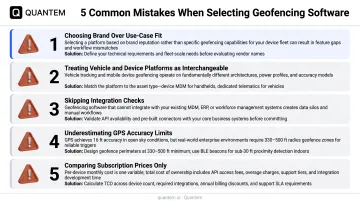
- Choosing on brand name alone instead of fit for the primary use case (device management vs. vehicle telematics vs. asset tracking)
- Treating vehicle fleet tools (Geotab, Verizon Connect) and device MDM geofencing (Quantem, AirDroid) as interchangeable—they are different architectures
- Skipping integration checks with MDM, ERP, CRM, or field service systems, including API availability and supported data fields
- Underestimating accuracy limits: GPS.gov cites about 16 ft under open sky, while Android recommends roughly 330–500 ft (100–150 m) radii for reliable alerts; buildings and tunnels degrade GPS further
- Comparing subscription prices only, and missing hardware ($40–$300+ per fleet unit), activation fees, and typical 12–36 month contracts
The right geofencing software matches your operational goal: device compliance (Quantem), fleet productivity (Geotab), driver safety (Verizon Connect), or mixed-asset visibility (GPS Insight). Affordability, accuracy, and ease of use matter more than brand recognition when those outcomes are on the line.
Key Features to Look for in Geofencing Software
Not every geofencing tool gives you the same control. When you compare platforms for device fleets, field teams, or compliance-heavy environments, prioritize these four capabilities.
Real-time location tracking and alerts
Look for software that provides accurate GPS, Wi-Fi, or cellular tracking with instant notifications when devices or assets cross geofence boundaries. You need that speed for theft detection, HIPAA or DOT zone compliance, and time-sensitive work like job-site arrival checks and delivery proof.
What to verify:
- Baseline latency: Android's geofence service typically alerts in under two minutes while moving, 2–3 minutes under background limits, and up to six minutes when stationary
- Vendor sync intervals: Quantem offers 5-minute location sync on Professional and 2-minute on Enterprise; fleet platforms vary
- Field conditions: Test latency in your real environments (urban, indoor, rural) before deployment
Flexible geofence creation and management
The best solutions allow you to create custom-shaped zones (circles, polygons, or complex perimeters), name and organize geofences by location type (customer sites, yards, restricted areas), and easily edit or disable zones as operations change.
What to verify:
- Shape options: Quantem supports radius-based circles; GPS Insight offers circles and polygons; Geotab provides point-defined and square zones
- Organization tools: Named landmarks (GPS Insight), device/group/user targeting (Quantem, AirDroid), plus folders or tags for managing large zone sets
- Edit/disable controls: Can you pause a geofence without deleting it? Can you adjust radius without recreating the zone?
Comprehensive reporting and analytics
Evaluate location history, dwell time analysis, zone entry/exit logs, and filters by device, user, location, or timeframe. Those reports prove compliance for HIPAA and DOT audits, and they surface inefficient routes or unauthorized stops.
What to verify:
- Retention: Quantem offers 15-30 days of location history depending on plan; verify retention, export formats, and deletion controls with each vendor
- Filters: Can you filter by device, user, zone, or date range? Can you export timestamped entry/exit records?
- Actionable insights: Do reports show dwell time, frequency, route history, and unauthorized movement, or only raw location points?
Integration with existing systems
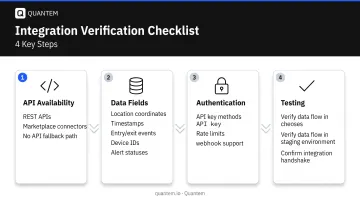
Ensure the software connects to your MDM, fleet, ERP, CRM, or workforce tools through APIs, native connectors, or marketplace apps. Without that link, location data stays siloed and teams fall back on manual workflows.
What to verify:
- API availability: REST APIs (Quantem, GPS Insight, Verizon Connect) vs. marketplace connectors (Geotab's 250+ partners) vs. no documented API
- Data fields: Can you pull location coordinates, timestamps, entry/exit events, device identifiers, and alert statuses programmatically?
- Authentication and rate limits: Quantem uses
x-quantem-api-key; confirm each vendor's auth method, rate limits, and webhook support
Conclusion
Choosing the right geofencing software starts with matching the platform to your asset type and operational goals.
- Mobile devices (compliance and security): Quantem offers affordable MDM geofencing with BYOD, policy automation, and SOC-2/GDPR/CCPA support.
- Commercial fleets: Geotab and Verizon Connect provide vehicle telematics, ELD compliance, and AI dashcam integration.
- Mixed assets (vehicles, trailers, equipment): GPS Insight's Landmark system supports fleets from about 10 to 5,000 units.
The strongest options in 2026 balance affordability, accuracy, ease of deployment, and actionable insights. Weigh total cost of ownership (subscription, hardware, and contract terms), boundary reliability in your real operating conditions, and fit with compliance and productivity goals—not brand recognition alone.
If you need an affordable, compliance-ready MDM platform with built-in geofencing, Quantem plans start at $1–3 per device and include a 21-day free trial with no credit card required. Contact sales@quantem.io or visit Quantem.io to learn more.
Frequently Asked Questions
How much does geofencing software cost?
Pricing varies by platform type. MDM solutions like Quantem run $1–3 per device/month, while fleet platforms like Geotab or Verizon Connect typically cost $20–50+ per vehicle/month. Factor in hardware ($40–$300+), activation fees, contract length, and whether geofencing is included or an add-on.
What industries benefit most from geofencing software?
Healthcare, field services, retail, logistics, construction, and government all benefit—from HIPAA device tracking and job-site arrival to fleet delivery verification and restricted-zone compliance. A 2024 fleet survey found GPS adoption at 83% in transportation, 70% in construction/field services, and 66% in government.
Can geofencing software track both devices and vehicles?
Some platforms support both; most specialize. Quantem and AirDroid focus on mobile devices via MDM, while Geotab and Verizon Connect target vehicles with telematics hardware. GPS Insight supports mixed assets. Choose based on device policy needs versus fleet telematics—not brand alone.
What's the difference between GPS tracking and geofencing?
GPS tracking continuously records real-time location and route history. Geofencing uses that data to trigger automated actions—alerts, locks, policy enforcement—when a device enters, exits, or dwells in a virtual boundary. It adds business logic and automation to raw GPS coordinates.
How accurate is geofencing technology?
GPS geofencing is typically accurate within 4.9 m (16 ft) under open sky (GPS.gov), but buildings, tunnels, and poor satellite geometry degrade results. Android recommends 100–150 m minimum radii for reliable detection. Field-test boundaries at your actual sites before relying on vendor claims.
Do I need special hardware for geofencing?
Device-based MDM geofencing (Quantem, AirDroid) works with existing smartphones and tablets—no extra hardware. Vehicle fleet solutions (Geotab, Verizon Connect) usually need installed GPS trackers at $40–$300+ per unit, though some plans include hardware with no upfront cost. Mixed-asset platforms may still require hardware for non-powered equipment.