Introduction
Cisco Meraki Systems Manager reaches end-of-sale on June 3, 2026, with final support ending June 3, 2029. Organizations still on Meraki SM need a replacement plan now—and a chance to drop the licensing pain and feature gaps that came with it.
Meraki SM offered cloud-managed MDM tied into networking infrastructure. The tradeoffs were recurring per-device licensing and thin support for advanced kiosk mode, multi-platform depth, and MSP-ready multi-tenancy.
When you evaluate replacements, prioritize lower total cost of ownership, deeper features (API access, geofencing, compliance certifications), and platforms built for endpoint management at scale. This guide compares the best Meraki MDM alternatives for 2026 so you can migrate with a clear shortlist.
Key Takeaways
- Meraki SM end-of-life makes migrating to more affordable, fuller-featured platforms urgent
- Strong alternatives deliver zero-touch enrollment, advanced kiosk mode, and multi-platform support for less
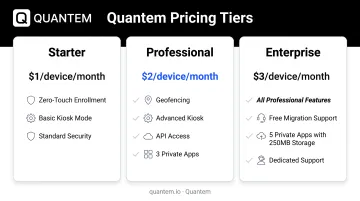
- Quantem leads on affordability at $1-$3/device/month with enterprise-grade features in all plans
- Low-disruption migration hinges on inventory audits, policy mapping, and a phased rollout
- Final SM purchases are allowed until June 3, 2026. Start evaluating replacements now
Overview of Cisco Meraki MDM and Why Organizations Are Seeking Alternatives
Cisco Meraki Systems Manager offered cloud-based MDM for enrolling, configuring, and securing Android, iOS, macOS, and Windows devices from the Meraki dashboard. It provided centralized control over device policies, app distribution, and security configurations for teams already invested in Meraki's networking ecosystem.
Cisco announced the end-of-life in December 2025, citing "limited growth and ongoing operational costs" as reasons. Organizations now face a mandatory migration with a three-year support window remaining. The June 3, 2026 deadline for new license purchases means planning must start now.
Pain Points Driving Organizations to Alternatives
Even before the end-of-life announcement, many organizations sought alternatives. Common complaints included:
- Per-device licensing fees that TrustRadius users said "can add up," with requests for flat or bulk rates
- Kiosk mode that lacked depth for digital signage, multi-app lockdown, and peripheral controls
- Limited control for rugged warehouse terminals, field devices, and industrial handhelds
- Vendor lock-in from Meraki networking integration that made standalone MDM evaluation harder
What Organizations Need in a Replacement
The ideal Meraki SM replacement should deliver:
- Lower total cost of ownership through transparent pricing, with no multi-year lock-in or hidden fees
- Advanced kiosk modes, API access, geofencing, and compliance certifications (SOC-2, HIPAA, GDPR)
- Native multi-tenancy for MSPs managing multiple client fleets from one console
- Security certifications included by default, not gated as premium-tier add-ons
The alternatives below close these gaps and give IT teams a clearer path off Meraki SM before support winds down.
Top Cisco Meraki MDM Alternatives 2026
We evaluated alternatives on:
- Pricing transparency
- Feature parity with or superiority to Meraki SM
- Ease of migration
- Multi-platform depth
- Kiosk and rugged device support
- MSP-readiness
The list prioritizes platforms that eliminate Meraki's licensing pain points while adding capabilities Meraki SM lacked.
Quantem
Quantem is a cloud-based MDM platform with zero-touch provisioning, built-in kiosk mode, and multi-platform support for Android, Windows, and iOS. It delivers enterprise security and features at a fraction of typical MDM costs.
Key differentiators:
- Enterprise security for everyone - SOC-2, GDPR, and CCPA compliance available in all plans, not just premium tiers
- No-friction trial - 21-day full-access trial with no credit card required
- Pay-as-you-go pricing - No cancellation fees or multi-year contracts
- Private app management - Version control included; up to 5 private apps with 250 MB storage in Enterprise
- API playground - Integrations with DevOps staging and testing capabilities
- Free migration support - Included in Enterprise plan to minimize transition friction
| Feature | Details |
|---|---|
| Pricing | $1-$3 per device/month; free migration support in Enterprise plan |
| Key Features | Zero-touch enrollment (all plans), built-in kiosk mode, geofencing (Professional+), API access, multi-platform (Android, Windows, iOS) |
| Best For | Healthcare, retail, warehouse/logistics, and field services needing affordable enterprise MDM with rapid deployment and no vendor lock-in |
Hexnode UEM
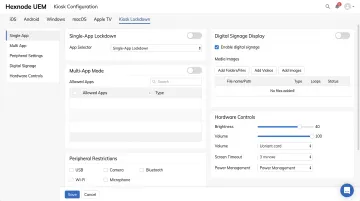
Hexnode UEM is a unified endpoint management platform with deep Android Enterprise support, advanced kiosk configurations, and native MSP multi-tenancy. Frequently cited as a top Meraki SM alternative in analyst reports, it earned a 7.4/10 rating across 26 reviews in direct comparisons.
Key differentiators:
- Deep kiosk configuration options - Single-app lockdown, multi-app mode, and digital signage configurations
- Extensive rugged device support - Zero-touch provisioning, remote control, geofencing, and battery controls for industrial devices
- Granular peripheral controls - Volume keys, notification shade, screen timeout, and hardware restrictions
- Remote cache clearing - Troubleshooting directly from the console reduces on-site visits
- Strong G2 ratings - 4.5/5 from 249 reviews, highlighting ease of use and support quality
| Feature | Details |
|---|---|
| Pricing | Tiered plans from $2.20-$4.70 per device/month; 14-day free trial available |
| Key Features | Advanced kiosk modes, rugged device management, Android/iOS/Windows/macOS/ChromeOS/Linux support, native MSP portal |
| Best For | MSPs and enterprises with dedicated-use devices (kiosks, POS systems, digital signage) requiring deep configuration control |
Miradore
Miradore is a cloud-based MDM focused on simplicity and cost efficiency. Its free tier supports up to 50 devices, making it accessible for SMBs testing MDM for the first time. G2 users rate it 4.6/5, emphasizing intuitive setup and administration.
Key differentiators:
- Free plan with core MDM - Enrollment, security policies, and app management for up to 50 devices
- Premium pricing - Starting at $2.75 per device/month when billed annually
- Strong Apple ecosystem integration - Apple Business Manager and Automated Device Enrollment support
- No forced multi-year contracts - Flexible terms without vendor lock-in
| Feature | Details |
|---|---|
| Pricing | Free for up to 50 devices; Premium from $2.75/device/month annually |
| Key Features | Multi-OS (Android, iOS, macOS, Windows), automated enrollment, app deployment, compliance policies, remote wipe |
| Best For | SMBs and mid-market teams wanting low-cost, low-complexity MDM with Apple ecosystem strength |
Microsoft Intune
Microsoft Intune is a cloud-based UEM included in Microsoft 365 E3, E5, and Business Premium subscriptions. It offers the tightest integration with Microsoft's identity and security stack, including Azure AD, Conditional Access, and Defender for Endpoint.
Key differentiators:
- Zero additional MDM licensing - Included in M365 E3/E5/Business Premium; standalone at $8/user/month
- Conditional Access integration - Gates app access based on device compliance and identity policies
- Autopilot - Zero-touch Windows enrollment with automated Azure AD joining
- App protection policies - BYOD support without full device enrollment
- Intune Suite - Advanced endpoint analytics available as per-user add-on
| Feature | Details |
|---|---|
| Pricing | Included in M365 E3/E5/Business Premium; Intune Suite $10/user/month add-on |
| Key Features | Windows/macOS/iOS/Android support, Conditional Access, Autopilot, app protection policies, Defender integration |
| Best For | M365-standardized enterprises wanting unified Microsoft ecosystem management with no separate MDM license |
NinjaOne
NinjaOne is a unified IT management platform combining RMM, MDM, patch management, backup, and remote access in a single SaaS console. Named a Leader in the 2026 Gartner Magic Quadrant for Endpoint Management Tools, it unifies mobile and desktop management under one roof.
Key differentiators:
- Broader scope than pure MDM - Covers mobile, desktop, and server management in one platform
- Condition-based script remediation - Automates fixes when monitoring rules trigger alerts
- Strong compliance posture - FedRAMP Moderate, SOC 2, ISO 27001 certified
- High G2 scores - Ease of Admin 9.4, Ease of Setup 9.4, Support 9.4
| Feature | Details |
|---|---|
| Pricing | $1.50–$3.75/device/month depending on scale; MDM is add-on to base RMM platform |
| Key Features | RMM + MDM + patching + backup; Android/iOS/macOS/Windows/Linux support; automated patch deployment; remote access |
| Best For | MSPs and IT teams needing unified endpoint management across mobile and desktop fleets, not just mobile-only MDM |
SOTI ONE Platform
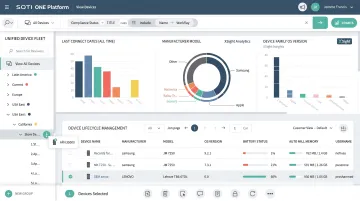
SOTI ONE Platform is an enterprise mobility management suite combining SOTI MobiControl (EMM), SOTI XSight (analytics), SOTI Snap (workflow digitization), and SOTI Connect (printer management). Trusted by 17,000+ enterprise customers globally, it specializes in complex, multi-site mobile operations.
Key differentiators:
- Full lifecycle device management - From deployment to retirement, with proactive issue resolution
- Real-time analytics - XSight enables proactive issue detection and resolution
- Frontline and rugged device strength - Proven in healthcare, retail, logistics, and emergency services
- Proven migration experience - Dedicated onboarding teams with tools and guidance for Meraki SM migrations
- Workflow digitization - SOTI Snap builds cross-platform process apps for field operations
| Feature | Details |
|---|---|
| Pricing | Enterprise quote-based; free trial available; migration assistance included |
| Key Features | EMM + analytics + workflow apps + printer management; multi-OS support; rugged device strength; MSP-ready |
| Best For | Large enterprises and MSPs managing complex, multi-site mobile operations with rugged devices and requiring dedicated migration support |
How We Chose the Best Alternatives
We scored each alternative on four factors:
- Total cost of ownership (upfront plus ongoing licensing)
- Feature depth relative to Meraki SM
- Migration complexity (API availability, zero-touch support)
- Vendor stability (product roadmap and support quality)
Common mistakes to avoid:
- Choosing on upfront cost alone: hidden fees, per-user vs. per-device models, and premium-tier locks inflate true cost
- Overlooking MSP multi-tenancy: confirm tenant isolation and delegated admin if you manage multiple clients
- Underestimating migration effort: policy mapping, zero-touch token reassignment, and re-enrollment need real coordination time
- Ignoring offline or on-prem needs: sites with poor connectivity may require offline policy enforcement or hybrid options
Why pilot deployments matter:
Test alternatives with a small device group (ideally IT-owned devices or a single department) before full rollout. Pilots confirm policy replication and user experience, and they surface configuration gaps early—when fixes are easier and less disruptive.
Key Considerations When Migrating from Meraki SM
A clean Meraki SM exit hinges on four workstreams: inventory, policy mapping, zero-touch tokens, and phased rollout. Skip any one and you risk orphaned devices or broken enrollment.
Start with Inventory Audit
Export your full device list from the Meraki dashboard before licenses lapse. Use the Meraki API to capture:
- Serial numbers and device identifiers
- OS versions and hardware models
- Active policies, restrictions, and security settings
- License expiration dates
- VPN profiles and Wi-Fi configurations
Use this export to map devices onto the new platform and catch every endpoint before licenses expire.
Map Policies to Target Platform
Identify which Meraki restrictions, security settings, compliance rules, and app configurations have direct equivalents in the replacement MDM. Flag areas requiring rebuilding:
- VPN profiles - May need to be recreated from scratch
- Wi-Fi payloads - Certificate-based authentication requires careful migration
- Custom restrictions - Not all platforms support identical control sets
- Compliance rules - Verify that conditional-access logic translates accurately
Confirm Zero-Touch Readiness
Cisco's migration guide specifies:
- Apple devices - Create a new Apple Push Certificate and reassign devices to the new MDM in Apple Business Manager
- Android Zero-Touch - Keep the Android Enterprise admin binding until the new MDM is ready; ZTE applies the EMM config at first boot
- VPP tokens - Redownload Volume Purchase Program tokens from Apple Business/School Manager
Losing zero-touch token ownership requires complex re-registration and delays rollout.
Plan Phased Rollout
Avoid migrating all devices at once. Cisco recommends testing 1-2 devices first, then expanding gradually:
- Pilot group - IT team devices or a single department
- Validate configurations - Ensure policies behave as expected and troubleshoot issues
- Expand deployment - Roll out across wider organization or customer base in waves
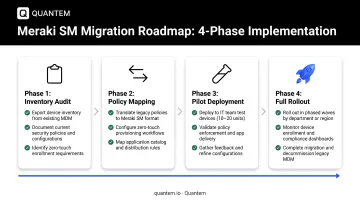
Phased rollout limits production disruption and gives IT time to refine configs between waves.
Conclusion
Meraki SM end-of-life is a forced migration, and a practical window to move onto more affordable MDM platforms. You can drop per-device licensing pain and pick up capabilities Meraki lacked: advanced kiosk modes, deeper analytics, MSP multi-tenancy, and stronger compliance coverage at lower cost.
Final SM license purchases are allowed until June 3, 2026, with support ending June 3, 2029. Start evaluating alternatives now so the move stays planned instead of rushed.
If you want enterprise features without enterprise pricing, Quantem includes zero-touch enrollment, built-in kiosk mode, and SOC-2/GDPR/CCPA compliance at $1–$3 per device/month. Start the 21-day free trial (no credit card required). For broader IT management, explore NinjaOne or SOTI ONE for unified RMM+MDM platforms.
Frequently Asked Questions
What is replacing Meraki MDM?
Several MDM platforms are replacing Meraki Systems Manager. Common picks include Quantem ($1–$3/device/month), Hexnode UEM, Microsoft Intune, NinjaOne, and SOTI ONE—each aimed at different budgets and use cases.
Does Meraki have an MDM?
Yes, Cisco Meraki offered Systems Manager (SM) as its MDM product, but it reached end-of-sale in December 2025. Final purchases are allowed until June 3, 2026, with support ending June 3, 2029. Existing users must migrate to alternative MDM platforms before support ends.
When does Meraki Systems Manager support end?
Meraki SM support ends June 3, 2029. However, new license purchases are only allowed until June 3, 2026. Organizations should plan migrations well before the 2029 deadline to avoid operating on unsupported software and ensure compliance.
How much does Cisco Meraki MDM cost compared to alternatives?
Cisco does not publish Meraki SM pricing publicly—buyers must contact sales. Transparent options include Quantem at $1–$3/device/month, Hexnode at $2.20–$4.70, Miradore from $2.75/device/month (annual), and Microsoft Intune included with M365 E3/E5 at no extra MDM cost.
Can I migrate from Meraki SM without disrupting operations?
Yes, with a staged plan. Export inventory and policies via the Meraki API, map them to the new platform, reassign Apple Business Manager and Android Enterprise bindings, then pilot before full cutover. Most alternatives offer migration support to limit downtime.
What features should I look for in a Meraki MDM replacement?
Prioritize zero-touch enrollment (Apple ADE, Android Zero-Touch), kiosk/lockdown controls, multi-platform support (Android, iOS, Windows, macOS), and compliance (SOC-2, HIPAA, GDPR). Also weigh transparent pricing, API access, and MSP multi-tenancy if you manage multiple clients.